San Diego County advances $2.5 million project to curb toxic air in Tijuana River Valley
Published in News & Features
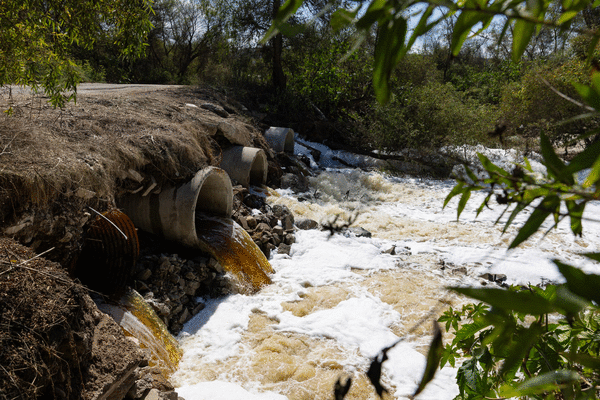
SAN DIEGO — The San Diego County Board of Supervisors on Tuesday advanced a $2.5 million project meant to reduce toxic air pollution at Saturn Boulevard, the South County hot spot where cascading Tijuana River flows release hydrogen sulfide into nearby neighborhoods.
The board voted to adopt a memorandum of agreement with the city of San Diego, authorizing the county to advertise and award a construction contract.
At the crossing, in the Nestor area near Imperial Beach, polluted river water flows during dry weather through two to three culvert pipes and spills into a downstream pond. Turbulence there causes foaming and releases noxious gases, mainly hydrogen sulfide, causing nearby residents to experience symptoms such as headaches and nausea.
The project will attach high-density polyethylene pipe to two of the existing culverts. The extensions will run about 40 to 60 feet into the pond so the flow discharges below the water’s surface. The report says the extensions are designed so they will not raise flood levels.
Construction is projected to begin in early 2027 and finish by summer 2027, though weather and an anticipated El Niño could affect the timeline, according to a county staff report.
“In January, I told the families living near Saturn Boulevard that we were done waiting and would fix what we can right now,” Supervisor Paloma Aguirre said in a news release. “We set aside the money. Today, we have a partner, a plan, and a contract ready to go out to bid. It’s not the permanent fix, and I won’t pretend it is. But construction starts early next year, and we will keep pushing until the permanent solution is built.”
The $2.5 million total includes $1,101,400 for design, environmental review, advertisement and construction management, and $1,398,600 for construction, including a 20% contingency. The money comes from prior-year general fund reserves the board set aside in January.
Under the agreement, the county will lead design, permitting, construction, coordination with the U.S. Navy and five years of monitoring. The report states the project sits on Navy property and is expected to trigger federal environmental review. The Navy has provided letters of support.
“The signing of this agreement is an important step toward delivering relief to residents who have endured air and water quality contamination for far too long,” San Diego Mayor Todd Gloria said in a statement.
The agreement also lays out a process for switching to a permanent solution if funding becomes available. On Sept. 1, the board unanimously approved $4 million for design, environmental review and permitting of a permanent box culvert at the site. That project would replace the pipe culverts and regrade the channel.
The California Coastal Commission approved the pipe extension in June. At that hearing, county Public Health Officer Dr. Sayone Thihalolipavan said Berry Elementary School, the monitoring site closest to the hot spot, was the only location in the region that had repeatedly exceeded the federal acute exposure guideline for hydrogen sulfide.
The site is within 1.5 miles of 11 schools. In September, the federal Agency for Toxic Substances and Disease Registry released a draft report that found short-term hydrogen sulfide exposure near the river to be a public health hazard.
_____
©2026 The San Diego Union-Tribune. Visit sandiegouniontribune.com. Distributed by Tribune Content Agency, LLC.






Comments