The wolf population has completely disappeared in Connecticut. Here's why another hybrid animal has taken over
Published in News & Features
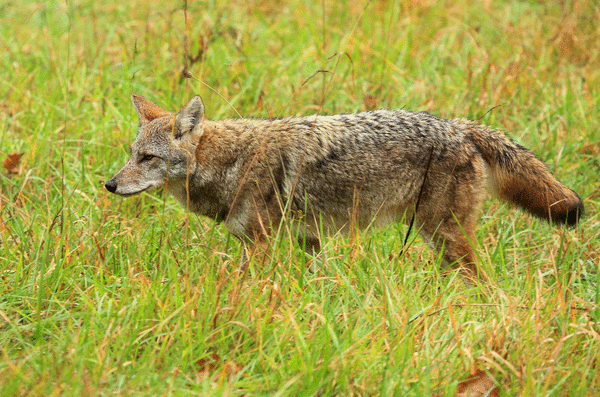
The Eastern coyote is now a common sight in Connecticut, with the population spreading across all of the state’s 169 towns and cities, but they haven’t been here for long, according to officials with the state’s Department of Energy and Environmental Protection.
Over the last 100 years, the coyote has spread from the western plains and midwestern United States to the Northeast, DEEP officials said. Coyotes were first reported in Connecticut in the mid-1950s. Throughout the 1960s and 1970s, most coyote reports were from northwestern Connecticut, according to Jason Hawley, state wildlife biologist with DEEP.
Coyotes have flourished in Connecticut because of their unique abilities to adapt to most environments and but also because they don’t face any significant competition or predation from other animals. Wolves, on the other hand, had a thriving population after European settlers moved into the area in the 1600s but then seemed to disappear 250 years ago. The last wolf in Connecticut is thought to have been killed in 1742 by Israel Putnam in the town of Pomfret. The historic site is now part of Mashamoquet Brook State Park, according to historical accounts.
“The government essentially waged war on large predators like wolves throughout colonial times and into the 1800s. When wolves were extirpated from the Midwest and the East, coyotes starting expanding eastward with little competition from wolves. As they expanded eastward, we know they did hybridize with wolves, because there were some still on the landscape.”
A new kind of coyote
The Eastern coyote now inhabits the entire east coast, according to Hawley. The species is considered highly adaptable. It can live in both rural and urban environments. Coyotes even have established populations in New York City and Chicago, according to Hawley.
The species, while similar to its western counterpart, is much bigger, with females typically weighing between 33 to 40 pounds, while males weigh 45 to 55 pounds. The animal measures roughly 48 to 60 inches from nose to tail and resembles a medium-sized dog, featuring longer legs, erect pointy ears, a bushy tail with a black tip, and coats ranging from gray and blonde to reddish or dark brown, according to the state’s DEEP.
But Eastern coyotes, unlike other coyote species, are considered a hybrid of coyote, wolf, and domestic dog genetics.
“If you talk to 10 different geneticists, you might get 10 different answers,” Hawley said. “But I think what everyone agrees on at this point is that they definitely have some wolf genetics in them. That’s why they are larger than western prairie coyotes. They also have some very small percentage of dog genetics. I’ve heard numbers that they are around 15% to 20% wolf and 5% to 10% domestic dog.”
According to the National Park Service, a genetics study conducted by Stony Brook University found that of 462 animals tested, the average genetic breakdown consisted of 64% coyote, 13% gray wolf, 13% eastern wolf, and 10% domestic dog.
“There are people who make a case they should be a new species altogether,” Hawley said. "But it’s tough because it’s a gradient, as you go west they become less Eastern coyote, and as you go North, coyotes are hybridizing with Eastern wolves. So it’s kind of like where do you draw the line? Because we see hybridization in other areas, too.”
The Eastern coyote adapted to human-disturbed environments over time and now thrives in close proximity to populated areas, according to Hawley. They are opportunistic omnivores feeding primarily on small mammals, vegetation, berries, and insects, alongside scavenging or occasionally targeting white-tailed deer. Coyotes will form small packs and use extensive vocalizations to defend territories and bond.
Hawley said that DEEP frequently gets reports of misidentified coyotes as wolves or other large canids. But according to Hawley, DEEP has never confirmed a wolf sighting in the state since the agency formed. Connecticut does not have any other native large canid species in the state. The red fox and gray fox, both native canids to the state, are much smaller and have distinct colors.
“We get a lot of confusion from people on what these canids are roaming around the state because they can all look so different,” Hawley said. “Some coyotes can have black coats, some have more red or white, they can even sometimes look wolf-like to the untrained eye. But they are not wolves or coydogs, they are Eastern coyotes. There’s a lot of confusion sometimes about what these animals are. They do look different from western coyotes because of their wolf hybrid mix. But anyone seeing a wild canid in Connecticut that looks like a wolf, is most definitely seeing an Eastern coyote.”
Dangers to small pets
Because of the close proximity to humans, coyotes can pose dangers to small pets, according to DEEP. Generally coyotes pose little threat to humans unless they have been habituated through intentional or unintentional feeding. A habituated coyote is a wild coyote that has lost its natural fear of humans — usually due to direct feeding or easy access to human food sources like garbage and pet food. Once a coyote loses their fear of humans, they can become unpredictable and dangerous, Hawley said.
Just last month, animal control officers in Fairfield issued a warning to residents, urging caution after two people were attacked.
“Like a bear they can become habituated,” Hawley said. “It’s very important people don’t feed them, whether intentionally or intentionally, through leaving dog or cat food out or trash with food scraps. If you see one, scare it by making loud noises. Scare them off the same way we recommend scaring a bear.”
Hawley said that while most healthy coyotes are afraid of humans, they do pose a danger to small pets including dogs and cats. Each year, he said that there “dozens and dozens” of reports across the state of dogs and cats being injured or killed by coyote attacks.
“By far, the most common conflict we see with coyotes is with pets. Even if you’re not aware of coyotes where you live, they are still there. Coyotes are in every town in Connecticut. Everyone should assume a coyote is not far away.
Officials suggest that people always keep an eye on their pet while outside, and dogs should be kept on a leash. “We frequently get reports of someone letting their dog out at night for a few minutes and a coyote attacks it,” Hawley said. “Sometimes we get reports of people letting their dog out and sadly it doesn’t come back. Whenever a pet goes missing, it’s almost certainly a coyote.”
Hawley said the majority of conflicts between humans and coyotes occurs when a pet owner tries to save their pet from an attacking coyote. Often times, people will get in the way to save their pet, resulting in getting bit or scratched in the process. Coyotes can carry rabies and any abnormal behaviors should be reported, he said. Anyone who is bit or scratched should immediately seek medical attention and report the attack to police.
Coyotes mate in late January into February, with den preparation and selection during March and actual denning and whelping of five to seven pups in April, he added. Coyotes are known to become more aggressive around mating season. In some towns they run through backyards and howl through the evenings.
“People should keep their dogs on leashes when walking through the woods, especially during mating season when there are small pups in dens,” Hawley said. “Small dogs should always be watched, and it’s important for pet owners to keep an eye on them. Coyotes will also attack cats. We get calls all the time from cat owners who say their outdoor cat has suddenly disappeared. If you have a cat that lives outside, you should assume it will get taken by coyotes at some point. That’s just the reality of any small animal that is outside unsupervised because we have a lot of coyotes.”
To help keep you and your pets safe, DEEP officials offer the following suggestions.
—Do not allow pets to run free. Keep cats indoors, particularly at night, and dogs on a leash or under close supervision at all times. The installation of a kennel or coyote-proof fencing is a long-term solution for protecting pets. A variety of livestock fencing and small animal pen designs can protect farm animals. An invisible electric fence is not effective in protecting dogs from coyote attacks.
—Never feed coyotes. Do not place food out for any mammals. Clean up bird seed below feeders, pet foods and fallen fruit. Secure garbage and compost in animal-proof containers.
—Always walk dogs on a leash. If approached by a coyote while walking your dog, keep the dog under control and calmly leave the area.
—Do not run or turn your back. Coyotes are territorial and many reports of bold coyotes visiting yards, howling or threatening larger dogs can often be attributed to this territorial behavior.
—Attempt to frighten away coyotes by making loud noises (e.g., shouting, air horn) and acting aggressively (e.g., waving your arms, throwing sticks, spraying with a hose).
—Be aware of any coyote behaving abnormally or exhibiting unusually bold behavior (e.g., approaching people for food, attacking leashed pets that are with their owners, stalking children, chasing joggers or bikers, etc.) and report these incidents to authorities immediately.
—Be aware of and report any coyotes exhibiting behavior indicative of rabies, such as staggering, seizures and extreme lethargy. Daytime activity is not uncommon and does not necessarily indicate rabies.
—Teach children to recognize coyotes and to go inside the house (do not run) or climb up on a swing or deck and yell if they are approached.
—Educate your neighbors. Ask them to follow these same steps.
—Regulated hunting and trapping may be used to remove problem coyotes in areas where it is safe and legal to do so.
Officials with DEEP’s wildlife division said they do not remove problem coyotes but may issue a permit to landowners or municipalities to employ a licensed Nuisance Wildlife Control Operator, who is qualified in advanced trapping, to target coyotes that have attacked supervised pets or penned farm animals, are diseased or have threatened public health and safety.
_____
©2026 Hartford Courant. Visit courant.com. Distributed by Tribune Content Agency, LLC.






Comments