US allies see a weakened Trump but they're wary of the backlash
Published in News & Features
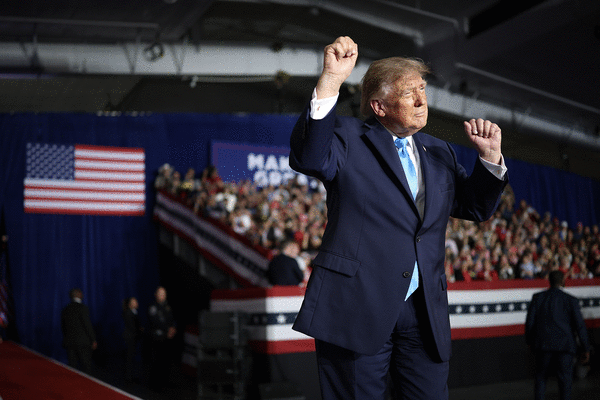
The U.S. election results were welcomed in many capitals for the limits that could place on Donald Trump, particularly on Iran, but foreign officials cautioned that the American preisdent could prove even more disruptive during the final two years of his term.
“On international affairs, he remains in charge,” French Finance Minister Roland Lescure told RMC radio on Wednesday. “You know how unpredictable the U.S. president can be.”
Trump’s Republican Party lost control of both houses of Congress in a historic midterm election dominated by the same sky-high energy prices that are blowing out budgets and spurring unrest around the world. The defeat was accepted by Trump, who acknowledged in an interview with Fox News that at least “part of it was Iran” and separately told the Financial Times he had no immediate plans to escalate with Tehran.
Still, U.S. allies, who have been repeatedly caught out by Trump over the past decade, cautioned that the president retained the power to surprise in matters of foreign affairs where Congress wields limited influence. Some European officials have privately expressed concern for weeks that Trump might escalate in Iran after the midterms.
“Either he decides to rise above the fray and acknowledges that things need to change,” Lescure added, “Or he doesn’t. Frankly, we’re going to have to watch this closely over the coming days.”
The president still has two months before Congress officially changes hands and Democrats gain the power to pass legislation, withhold funding and advance resolutions constraining his power to wage war. Trump’s actions toward Iran in the next few weeks may provide the clearest signal about how he will handle that challenge.
Iranian Parliament Speaker Mohammad Bagher Ghalibaf cheered the election result in a post on X, saying that Americans had said “NO TO WAR” because of either “conscience or the cost of living.”
The result will also strengthen the hand of those who advocate giving greater support to Kyiv through what’s expected to be another difficult winter under bombardment from Russia. Though the president will still have broad control over U.S. foreign policy.
Russian Deputy Foreign Minister Sergei Ryabkov told state news service RIA that the country won’t change its approach toward Ukraine, despite what he said was the Democrats’ “sharply negative” policy toward Moscow.
While the president retains wide latitude to levy tariffs, Republican losses in states hardest hit by trade wars could limit his ability to escalate conflicts with Canada and Europe. Trump could conversely be restricted from any further opening to China, since there’s bipartisan support in Congress for taking a hard line with Beijing. He may be under siege from investigations into administration officials.
“The remainder of President Trump’s term will be marked by impeachments, vetoes, and a certain paralysis,” Czech Prime Minister Andrej Babis told reporters. “On the other hand, of course, Trump will simply do whatever he wants. Let’s hope he returns to his promise to end the war in Ukraine and ends the conflict in the Strait of Hormuz.”
Some left-leaning European officials said they hoped the U.S. midterms, which followed similar results in Hungary, Serbia and Brazil, would revise expectations for far-right gains in places like France next year. U.K. Prime Minister Andy Burnham believes the result could signal the beginning of the end of the global far-right movement, British officials said.
Spain’s socialist prime minister, Pedro Sanchez, who faces his own test at the polls later this month, said on X that the U.S. had voted against “against policies that only serve to make people poorer. Against hatred. Against sexism. Against climate change denial.” He predicted: “it will happen soon in Spain.”
European officials warned that the U.S.’s relationship with its allies had been permanently undermined by Trump’s actions in his second term, including new overtures to Russian President Vladimir Putin. He has signaled support for far-right parties in Europe, threatened to seize Greenland from Demark and blindsided partners with a successful raid to oust Venezuelan President Nicolas Maduro.
Some Europeans have shown less concern for drawing Trump’s ire in the run up to the election, including British Foreign Secretary Ed Miliband’s public rebuke to Russian counterpart Sergei Lavrov at Group of 20 meetings in Atlanta last week. One senior European official said the continent needed to continue derisking from its dependence on American security support regardless of the result.
South African President Cyril Ramaphosa, whose country has seen relations with the U.S. plunged into a deep freeze under Trump, expressed hope for a “new era in world relations” in the coming years. “We’re hoping that, on a bilateral basis, there will be a coming together of minds, where we will find a proper path forward on geopolitics, as well as on trade matters and investment matters,” Ramaphosa said.
Bilahari Kausikan, Singapore’s former permanent secretary for foreign affairs, played down the election’s impact on Trump, citing the president’s response to losing the U.S. House of Representatives in his first term. Even after Tuesday’s gains, the Democrats will lack the numbers necessary to override a presidential veto, a power that Trump has signaled that he may be ready to use.
“I expect louder than usual noise over passing the budget, debt ceilings and a flurry of attempts at revenge impeachments of various officials and Cabinet members,” Kausikan said, predicting “no major change of policy direction” on China, Iran or tariffs. “If I were a gambling man, I would give even odds that Trump will feel ‘liberated’ and double down on what he wants to do.”
_____
—With assistance from Andrea Dudik, Philip J. Heijmans, Eltaf Najafizada, Michal Kubala, Paul Richardson and Daniel Basteiro.
©2026 Bloomberg L.P. Visit bloomberg.com. Distributed by Tribune Content Agency, LLC.





Comments