G7 nations issue Haiti statement, warnings as anti-gang operations intensify
Published in News & Features
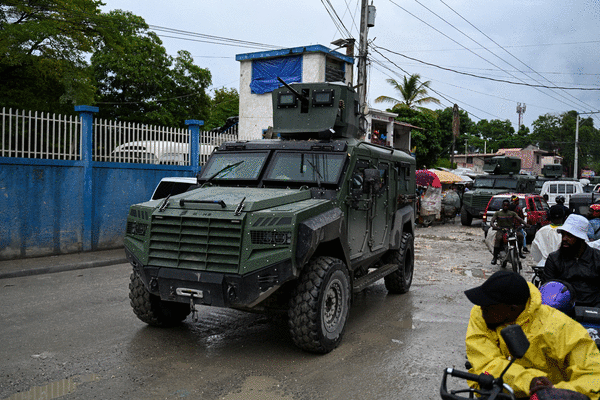
Foreign ministers from the Group of Seven wealthy nations are throwing their support behind the United Nations-authorized Gang Suppression Force in Haiti as a massive buildup of Salvadoran military troops in the country raises concerns about coordination, accountability and protection of civilians during the stepped-up fight against powerful armed gangs.
In a joint statement issued at the conclusion of their meeting in Paris, the G7 foreign ministers on Wednesday welcomed the recent six-month renewal of the force’s mandate through March 2027, saying the international armed mission was essential to helping Haiti restore security and stability.
But the foreign ministers of Canada, France, Germany, Italy, Japan, the United Kingdom and the United States also delivered a pointed message about the need to break gangs’ control while ensuring that security operations protect civilians. Their statement comes as roughly 2,500 Salvadoran soldiers deployed by President Nayib Bukele join the fight against armed groups in Haiti, and a separate drone task force intensifies attacks on their strongholds.
The group welcomed “the renewal of the U.N. sanctions regime, which promotes accountability for individuals and entities who threaten peace, security, and stability in Haiti,” while also warning that the participation of sanctioned individuals in the country’s long-delayed electoral process could undermine its credibility.
“We called for international support to strengthen the Haitian national police and Haitian Armed Forces, uphold the rule of law, and combat impunity,” the statement said. “We also called on all security actors operating in Haiti to prioritize the protection of Haitian civilians in all security operations.”
The unprecedented deployment of Salvadoran troops to Haiti, under a bilateral agreement between Haiti and El Salvador, has excited the Haitian population and added momentum to the fight against gangs. At the same time, however, it is raising questions and concerns about who is directing operations, how the five different forces on the ground are preventing conflicts among each other and who would be held accountable for possible abuses by Salvadoran troops.
Bukele launched the deployment after four of his aviation technicians assigned to the GSF disappeared after a gang ambush on Oct. 18. Although he has described the buildup as a search-and-rescue mission, his public taunts and aggressive use of social media to promote the deployment have exposed tensions in the effort to help Haiti wrest control from gangs that control large swaths of its capital.
The vast majority of the 2,500 Salvadoran soldiers are operating outside the command structure of the Gang Suppression Force or monitoring mechanisms of the U.N. Support Office in Haiti, which was established to provide logistical and operation support to the international mission.
With missions overlapping, and Bukele’s sophisticated use of social media, it’s becoming increasingly difficult to determine which forces are responsible for which operations. This has not only added to the confusion but also concerns among diplomats and humanitarian groups demanding deconfliction to prevent civilian casualties.
Among those sounding the alarm are the operators of Centre Hospitalier de Fontaine, a full-service hospital located in gang-controlled Cité Soleil where a drone strike by the task force operating out of the prime minister’s office led to the deaths of a prominent gang leader, along with some of his gunmen and civilians last week. The hospital has issued an urgent appeal for humanitarian coordination and a tactical exclusion zone to protect its facility, patients and medical personnel from being mistakenly targeted or caught in the crossfire.
Amnesty International wants deployment agreement made public
While Bukele has gained international attention for his crackdown of gangs in El Salvador, his Haiti deployment is drawing scrutiny from human rights organizations outside the country.
Earlier this week, Amnesty International called on Bukele’s government and Haiti’s to publicize the agreement governing the deployment, including to whom the forces are accountable, how the deployed forces are supervised, what rules govern their use of force and mechanism for investigating possible abuses.
“The Prime Minister of Haiti, Alix Didier Fils-Aimé, and the President of El Salvador, Nayib Bukele, must ensure that all operations conducted by Salvadoran forces in Haiti comply with international human rights law,” said Ana Piquer, Amnesty International’s Americas director.
“The Haitian prime minister’s commitment not to tolerate violations must translate into effective safeguards,” she added.
The organization warns that security operations could exacerbate risks for communities already devastated by the fallout of the gang violence, particularly when conducted near homes, schools and hospitals, Amnesty said.
“Both governments must take effective measures to protect people’s lives and physical integrity, prevent forced displacement, and ensure access to food and medical care,” Amnesty said. “Any use of force must comply with the principles of legality, necessity and proportionality. Protecting children, including those recruited by armed gangs, requires personnel trained in human rights, specific protocols and specialized care.”
More than 1,500 Haitians killed last quarter
Amnesty’s concerns, as well as those of the G7 nations, come as a new U.N. report continues to show the staggering human toll of Haiti’s security crisis —including civilian deaths during operations targeting gangs.
At least 1,167 people were killed, and 459 others were injured in Haiti between July 1 and Sept. 30, according to a report released on Wednesday by the U.N. Integrated Office in Haiti known as BINUH.
The report details massacres, kidnappings, sexual assault and other abuses linked to gangs fight to consolidate territory, and expand into new areas.
In the sprawling Cité Soleil seaside slum, gang members beheaded at least 19 people, including 12 elderly women, in early August.
In Kenscoff, the mountainside community overlooking Port-au-Prince, two attacks carried out in July and August left at least 105 residents dead, including 19 children. Among the victims were more than 36 were shot dead in the courtyard of a Protestant church.
The U.N. also documented attacks in Saint-Michel-de-l’Attalaye in the Artibonite region and in Marigot in the southeast, areas that had previously been largely spared gang infiltration.
“The scale of the massacres documented during this period, particularly in Kenscoff and several other localities that had previously been spared, reminds us of the absolute need to strengthen both mechanisms for protecting the population and the presence of the State in recently liberated areas,” said Carlos Ruiz Massieu, the special representative of the U.N. secretary-general in Haiti and head of BINUH.
Kidnappings also surged during the quarter with at least 137 people abducted for ransom, compared with 81 between April and June. Children accounted for 10% of the victims. Among those still being held are James Boyard, the chief of staff in Haiti’s defense ministry, and his 6-year-old daughter, who were abducted in mid-June.
Sexual violence also remains widespread, the U.N. said. The office documented at least 344 individuals who were victimized by gang members. They ranged in age from eight to 75 and more than three-quarters of the cases involved gang rape.
The report also highlighted the continued recruitment and exploitation of children by armed gangs. Efforts by Haitian authorities with support from international partners to strength prevention and protection, remain insufficient, the U.N. said.
Among the report’s troubling findings, which underscore concerns about collateral damage in the fight against armed gangs, is the toll of the operations on civilians.
While gang members were responsible for more than 45% of those killed or injured during the operation, more than half of the people were killed or injured during ground or aerial operations carried out by security forces against gangs, sometimes with the support of the private military company using drones, the report said.
More than 16% of the victims of these operations were not associated with gangs. At least four people, including two children, were also killed, and 10 others injured in attacks carried out using explosive drones, during the period.
Separately the U.N. office documented 44 cases of extrajudicial executions and attempted extrajudicial executions involving members of the Haiti National Police, compared with 14 in the previous quarter.
The U.N. Integrated Office reiterated that operations to combat gangs must comply with international human rights law and that alleged violations must be investigated. Its findings underscore the difficult balance confronting Haiti as operations to dismantle gangs gain momentum.
Elections risks
The G7 foreign ministers also weighed in on Haiti’s efforts to return to democratic order after more than a decade without an election.
Initially scheduled for Dec. 13, the first general elections since 2016 have now been postponed until July 2027 amid persistent insecurity and logistical challenges. The vote has drawn scrutiny, however, after election officials modified the decree governing candidates’ eligibility and a number of controversial presidential hopefuls entered the race.
While the Trump administration has not publicly taken a position on the candidates, Canada and the European countries have been outspoken about the participation of sanctioned individuals in Haiti’s electoral process, which was underscored by the G7.
“We noted concerns regarding the participation of sanctioned individuals in the political process which undermines accountability and public trust,” the statement said. “The people of Haiti have a right to determine their future through credible democratic processes and leaders who serve the public interest with integrity.”
The online registration period for presidential and legislative candidates ends at midnight on Sunday, Nov. 15, while the period for submitting the required documents to complete candidates’ files ends on Nov. 30. As of Wednesday, some 26 individuals had registered as presidential candidates, including figures sanctioned by the U.S., Canada and the European Union.
Meanwhile, the Provisional Electoral Council continues to struggle to register voters. Just 936,279 Haitians had registered to vote out of possible electorate of 6.5 million voters.
Political parties and grouping have also struggled to meet a minimum membership requirement of 30,000 people in order to field candidates. Of 316 political organizations that initially registered for the elections, 105 were approved. Of those, just 31 political parties and 17 political groupings have met the threshold in a registration process that has also been marred by attempts to register millions of fraudulent identification numbers.
The G7 emphasized the need to protect the credibility and integrity of the electoral process and called on Haitian authorities to ensure the full and impartial implementation of the electoral decree. The warning reflects growing concerns that Haiti’s elections, if not conducted right, could plunge the country into an even deeper crisis.
Beyond security and elections, the foreign ministers also expressed alarm over the deepening humanitarian situation, which this week was compounded by heavy flooding in certain regions of the country.
Nearly 60,000 people were affected by floods after more than 13,000 homes were inundated with water, the U.N. said Wednesday. The disaster has added to the suffering of an estimated 1.5 million Haitians who have been displaced by gang, and the more than 6 million struggling to find enough to eat.
The G7 urged government to increase their humanitarian contributions as well as their support for the U.N. trust fund helping finance the security operations.
“We urged the international community to intensify the financial contributions to the U.N. Trust Fund, recognizing that the success of the UN-mandated hybrid mission depends on sustained multilateral support to resource its operations. We urged critical international support for humanitarian assistance for Haiti, in order to address the multiple crises facing the people of Haiti,” the G7 said.
©2026 The Kansas City Star. Visit at kansascity.com. Distributed by Tribune Content Agency, LLC.




Comments