'Broadview Six' judge slaps down DOJ request for her to step aside in fight over privileged material
Published in News & Features
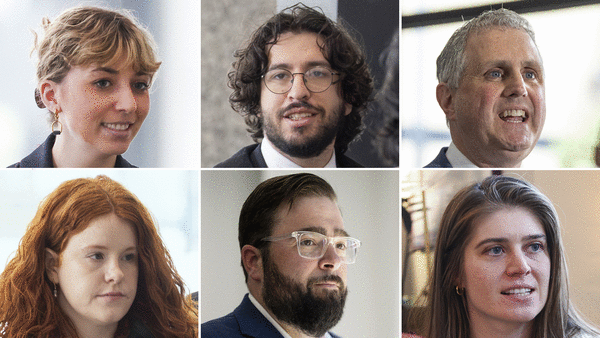
CHICAGO — A Chicago federal judge on Friday issued a quick slap-down of a U.S. Department of Justice request for her to step aside in deciding what materials are privileged in her ongoing inquiry in the “Broadview Six” case, saying the government waited until the 11th hour and has a “basic misapprehension” of how the system works.
Associate Attorney General Stanley Woodward had argued in a motion Thursday it was “beyond dispute” that U.S. District Judge April Perry plans to take testimony next month from U.S. Attorney Andrew Boutros and others as part of “an Article III criminal contempt inquiry.”
Woodward said Perry’s role as both prosecutor and judge means she “cannot be the one to rule” on what evidence is off-limits, and asked her to appoint a special master or an “otherwise disinterested judicial officer” to rule on privilege issues ahead of the Dec. 2 hearing.
But Perry was having none of it. In a ruling denying the request posted to the court docket Friday morning, Perry said the “substance of the motion reflects a basic misapprehension about what a special master does.”
“A special master is an arm of the Court who is supervised by the Court,” Perry stated in her order, which was handed down just 14 hours after Woodward’s request. “Special masters are not ‘disinterested judicial officer(s),’ nor do they have the power to issue a final ruling on legal issues…Therefore, this Court would have to make its own determinations regarding privilege even if a special master was appointed.”
Perry said the case law cited by Woodward in support of his position was off point, and rejected the premise she has assumed any executive-branch function. The Supreme Court has held that a judge has the inherent power to conduct and independent investigation into any attempt to defraud the court, Perry said.
“That is precisely what the Court intends to do here,” Perry wrote.
The judge also said Woodward’s motion was “untimely,” given that the government has known for more than five months that she planned to hold a hearing on the alleged prosecutorial misconduct in the “Broadview Six” case, and that “potentially privileged communications would be at issue during that hearing.”
“Despite this, the Government waited until 6:50 p.m. the night before potentially privileged materials would be tendered to the Court to file its motion,” she said.
Perry’s ruling was in line with what she said at a hearing earlier this week, telling Woodward she does not intend “to ask any questions that will call for a privileged answer,” and that judges routinely are allowed to view evidence that is later determined to be off-limits in making a judicial ruling, such as in bench trials and certain pretrial evidentiary hearings.
The ruling leaves in place Perry’s order for attorneys for three assistant U.S. attorneys involved in the Broadview case to submit in writing by Friday what relevant portions of their expected testimony will be and “why any potential privilege should not apply.”
Responses from the government on what it thinks should be privileged are due by Wednesday.
Perry has so far shot down attempts by the Justice Department to limit or derail the proceedings, which could offer the spectacle of Boutros being ordered by his bosses in the attorney general’s office not to answer certain questions, or even with Chicago’s top federal law enforcement officer asserting his Fifth Amendment rights.
For their part, attorneys for current prosecutors William Hogan, Matthew Skiba and Andres Almendarez all told the judge on Monday they don’t intend to individually assert any privileges. Attorney Shelly Kulwin, who represents Hogan, said the veteran prosecutor had nothing whatsoever to hide. “We both have more sunsets behind us than in front of us,” he said.
“He’s happy to fully explain his thought processes, who he talked to, who he didn’t,” Kulwin said. “He’s just going to say what happened. That’s not a problem.”
Boutros did not attend that hearing, and no private attorney has signed on to the case to represent him.
The Broadview Six indictment was one of the most serious cases brought against protesters during Operation Midway Blitz, the Trump administration’s aggressive deportation push last fall.
The felony charges alleged the six defendants — most of whom had ties to local Democratic politics — crowded around an ICE agent’s vehicle outside the Broadview ICE facility in September 2025, banged on the car and windows, and pushed against it to hinder and impede its movement.
Boutros was forced to drop all charges after it was revealed the lead prosecutor, Sheri Mecklenburg, had allegedly committed misconduct before the grand jury.
Woodward, who took over the case just three weeks ago, has said in court filings that communications between the U.S. attorney’s office and DOJ about the indictment are largely off-limits to her investigation because of government privileges such as deliberative process and attorney work product.
In a filing last week, Woodward said witnesses that Perry has ordered to testify under oath, including U.S. Attorney Andrew Boutros, have all been instructed to assert those privileges and that to put them on the stand and “judicially cross-examine them” would pose an “intolerably high risk” of violating their rights.
____
©2026 Chicago Tribune. Visit at chicagotribune.com. Distributed by Tribune Content Agency, LLC.



Comments