British Prime Minister Burnham's brush with Europe shows how hard rejoining would be
Published in News & Features
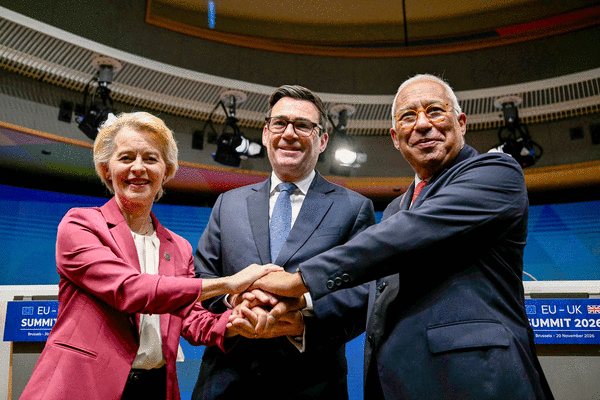
LONDON — Andy Burnham experienced his first encounter with the harsh realities of talks with the European Union after last-minute wrangling over the final details of a youth visa program threatened to overshadow his landmark Brussels summit.
Hours before Burnham was expected to stand side by side with EU officials and tout a long-awaited deal for closer ties, the bloc suggested the whole thing would be on hold while the two camps negotiated for another six months on tuition fees. It was a particularly hard line to take, considering the United Kingdom had a day earlier conceded on a key questions on how many young people could take part in the so-called Youth Experience Scheme.
While Burnham and European Commission President Ursula von der Leyen later played down the dispute as a misunderstanding during an upbeat news conference Friday, it illustrated the challenge that Britain faces as it debates whether to move closer to the union. Anything Britain does to roll back its 2016 decision to leave EU is likely to prove even more difficult.
“It still being handled somewhat chaotically does suggest to me that the U.K. still has a lot to learn,” said David Henig, director of the European Center for International Political Economy. “Today does show that U.K.-EU deals are possible and indeed essential, given a trade relationship of this size, despite all the ongoing challenges.”
Europe’s 27 member states are reluctant to grant anything resembling membership without the tradeoffs that come with the status. And several of requirements, especially of free movement of people across borders, remaining politically fraught in Britain, despite polls showing strong support for closer ties.
“It’s ultimately, at the very end, for the people of the U.K. to decide where the journey goes to,” von der Leyen said.
Perhaps unsurprisingly, Burnham himself ended the day in Brussels by declaring that the deal would be the last of its kind before Britons get a chance to weigh in on the issue in the next general election. It was the latest sign that the prime minister, who has been on the job four months, was trying to slow things down after setting Westminster abuzz by suggesting that he was open to potentially rejoining the bloc.
“I take the view that just having better, more constructive, collaborative relationships with neighbors is just a good thing to do,” Burnham told reporters in the European Council offices. “Those who burnt our bridges in these buildings, 10 or so years ago, after the referendum, I think they did significant damage to Britain, and it’s why the status quo back at home just isn’t good enough.”
The agreements announced by the leaders Friday will help ease food trade, link carbon markets and enable young people to live, work and study in each other’s countries. The two sides also pledged to keep working on future economic alignment, with further talks expected on U.K. access to the EU’s “Made in Europe” trade and procurement policy.
But the EU is continuing to push for European students to be offered “home fees,” equivalent to the rate paid by British youths, which the U.K. isn’t ready to concede. The two sides set a six-month timeline to try and resolve the impasse.
Although the talks were initiated by Burnham’s predecessor, Keir Starmer, an agreement was long-delayed and represented a political win for the government in London. U.K. officials credited Burnham’s decision to embrace a more dramatic reset in a speech to the governing Labour Party’s annual conference with helping break the logjam.
“That is progress, I would say, not a fig leaf,” Burnham told a news conference with von der Leyen. “And I’m really proud of the fact that we’ve been able to achieve it.”
Burnham said the deal would add as much as 0.5% to Britain’s economic output, clawing back a portion of the 2 to 4 percentage points that Bloomberg Economics estimates leaving the EU cost. The government’s subsequent acknowledgment that the full effect of the deal wouldn’t be felt until 2040 prompted questions about whether it was worth the trouble.
The prime minister said the next 12 months would be spent “brainstorming” ideas with the EU for the future relationship between the U.K. and the bloc, arguing that “incremental steps” would only take Britain so far. Yet Burnham has also signaled a desire to protect key industries driving British growth, such as banking and AI, as he mulls closer ties.
While the U.K. continues to debate its own relationship with Europe, others without the baggage of having left the bloc, such as Canada, have jumped ahead in the conversation. Prime Minister Mark Carney’s plans to get as close to the EU as possible without becoming a member have been widely welcomed in Brussels.
Still, a shadow news conference in Brussels by Nigel Farage, who transformed his successful Brexit referendum campaign into one of Britain’s biggest political parties, highlighted the political opposition facing Burnham back home. A new pro-Brexit campaign named Stay Out attacked the “humiliating spectacle.”
“Burnham has been played like a fiddle by Brussels, which took one look at how badly he wants a deal and decided British taxpayers should foot the bill for cheaper fees for EU students before it will sign anything,” Stay Out Chair Oliver Lewis said.
Meanwhile, a group of Labour MPs who favor rejoining the EU were urging Burnham against being neutral in the conversation over the relationship. They argue he needs to back a formal campaign to re-enter the bloc or risk having efforts like Stay Out, as well as the Conservatives and far-right Reform party, gain ground because they’re able to articulate what they want.
There has been disappointment among this section of the Labour Party that Burnham has appeared to retreat from his ambitions to rejoin the EU by signaling he wants to slow the pace of those discussions.
Politics is an argument not a conversation, one Labour rejoiner said. A second said the danger is that Burnham loses the argument before he’s even started making it. Another said they believed a majority of the parliamentary Labour party supported rejoining the EU.
The challenges and limits on what could be achieved at this summit show that the choice is between rejoining in full or the status quo, one Labour rejoiner said.
Georgina Wright, European policy specialist at the German Marshall Fund, said despite the difficult talks, the EU and U.K. are optimistic about their future relationship for the first time in a long while.
“These are incremental, small things,” she said. “But they improve the general relationship.”
Anything further becomes more existential, however, forcing both sides to decide what they ultimately want.
“We have reached the end of incrementalism,” Wright said.
_____
(Alex Wickham contributed to this report.)
©2026 Bloomberg L.P. Visit bloomberg.com. Distributed by Tribune Content Agency, LLC.





Comments