Houthi hits on Saudi finance center extend tit-for-tat attacks
Published in News & Features
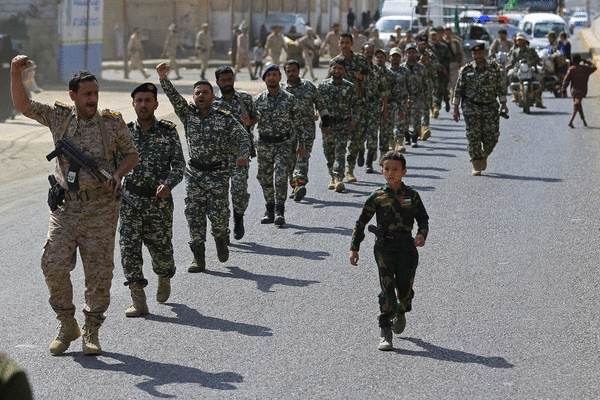
The Houthis struck Saudi Arabia’s main finance district for the second time in a week on Tuesday, extending a cycle of tit-for-tat attacks and complicating the kingdom’s push to establish its capital as a global business center.
Early on Wednesday, Saudi forces said they intercepted four drones fired at Ras Tanura on the Persian Gulf coast, where the kingdom has a major oil refinery and crude-export facilities. Saudi Arabia also said it targeted Houthi-controlled sites in the port of Hodeida and other areas of Yemen, where the Iran-backed militant group is based.
The attack on a tower in Riyadh injured 11 people, the Saudi civil defense agency said. Its statement on X carried a photo showing damage across several floors of the skyscraper housing the headquarters of the Public Investment Fund. It didn’t say when the photo was taken or specify if that was the tower that was struck.
While the drones at Ras Tanura were intercepted, some debris fell in the area, according to the anti-Houthi coalition.
Ras Tanura has the largest oil refinery in Saudi Arabia with a capacity of 550,000 barrels a day. It was damaged in an attack in October and the main crude-producing unit was offline for at least a month, according to consultancy Energy Aspects.
The Saudis and other state energy producers in the Gulf have boosted crude exports through the Strait of Hormuz since late September, bringing flows to near pre-war levels last month. But exports of refined products have lagged. Fuels are generally shipped on smaller vessels, with the state companies favoring larger tankers for voyages out of the Gulf given the higher costs of shipping and insurance.
Second front
Saudi-Houthi clashes reignited in July after a lull since 2022 and marked the emergence of the conflict as a second front in the U.S. war against Iran.
“The Houthis’ attacks against Saudi Arabia are being driven by the war inside Yemen, not the Iran war,” said Allison Minor, senior fellow in the Middle East Program at the Center for Strategic and International Studies in Washington. “But the two wars are intertwined in a variety of ways. If the Iran war re-escalates, Saudi Arabia could face simultaneous attacks from Yemen, Iran, and Iraq for the first time, significantly increasing the risk of a catastrophic attack.”
The Saudi capital has come under almost-daily Houthi attacks since early last month, with dozens of people being killed. The targeting of Riyadh’s finance center underscore the Houthis’ efforts to pressure the kingdom as it tries to attract billions of dollars of foreign investment and tourists.
Riyadh is now asking for more missile interceptors from allies, including the U.S., U.K. and France, Semafor reported on Tuesday, citing people it didn’t identify.
The Houthis claim that the Saudi-led coalition has killed dozens of people with its strikes on Yemen in recent weeks. Before its attack on Hodeida on the Red Sea late Tuesday, the coalition urged civilians to evacuate the port.
Saudi forces have struck Houthi infrastructure, including ports, airports, telecommunications facilities, and fuel and energy sites, around 750 times since early October, according to ACLED, which monitors conflicts around the world.
“We’re resilient enough to stand a prolonged conflict,” Saudi Finance Minister Mohammed Al-Jadaan said in a briefing with reporters. The idea “that Saudi Arabia can be blackmailed by missiles fired at civilian assets” is a “delusion,” he said.
Pro-Saudi forces in Yemen have stepped up attacks in recent weeks after the Houthis made gains in their push to extend control over areas near Bab el-Mandeb, a vital waterway for international shipping at the southern end of the Red Sea.
The U.S.-Iran war and the conflict with Houthis are taking a toll on regional economies, including that of Saudi Arabia. The kingdom expects its $1.3 trillion economy, the biggest in the Arab world, to contract 2.1% this year and its fiscal deficit to rise to 4.9% of output.
The repeated targeting of Riyadh’s financial district is hindering efforts by Crown Prince Mohammed bin Salman to attract international banks, investors and companies to the city, a central pillar of his economic diversification strategy.
The King Abdullah Financial District — home to the PIF and offices belonging to Saudi Aramco, Brookfield and Goldman Sachs Group Inc. — has been under remote-work orders since deadly Houthi attacks on Riyadh’s main airport last month.
Still, international interest in Saudi Arabia has not disappeared. Barclays Plc recently opened a Riyadh office, returning to the market after more than a decade, while Goldman Sachs, HSBC Holdings Plc and Fortress Investment Group participated in a major private credit transaction in the kingdom.
“We have a history of dealing with situations like this and we have a history of containing it and actually dealing with our opponents,” Al-Jadaan said. “Every time Saudi goes through one of these events, I think without exception, if you look at the history, it comes out of the other side stronger.”
—With assistance from Michael Gunn, Sherif Tarek and Anthony Di Paola.
©2026 Bloomberg L.P. Visit bloomberg.com. Distributed by Tribune Content Agency, LLC.






Comments