Q&A: North Texas director Gene Gallerano talks making his new horror film 'The Yeti'
Published in Entertainment News
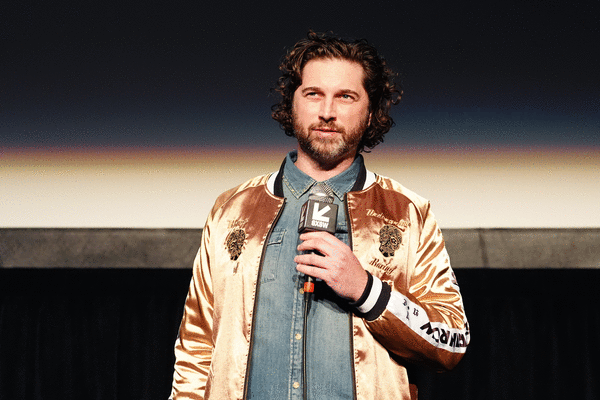
FORT WORTH, Texas — Gene Gallerano is glad to have a movie playing close to home.
The Dallas native has been working in filmmaking for two decades, racking up a number of acting and producing credits. In 2022, his team won best documentary for “The First Wave” at the News and Documentary Emmy Awards.
Gallerano’s latest project is something completely different for him — a 1940s-set snow-covered horror film called “The Yeti.”
“When an oil tycoon and a famous adventurer vanish into the harsh winter of remote northern Alaska, a hand-picked rescue team endeavors to bring them home. What they don’t know is that they are trespassing on the yeti’s territory, and the elements are the least of their worries. A blood-spattered survival horror featuring a towering beast and gruesome practical effects, ‘The Yeti’ hearkens back to a time when monster movies were king,” the film’s synposis reads.
“The Yeti” stars Brittany Allen, Jim Cummings, Christina Bennett Lind, Linc Hand, William Sadler, Corbin Bernsen and Fort Worth actor Eric Nelsen.
Gallerano co-directs, co-writes and co-stars in the film that opens in AMC theaters on April 4 and 8 as part of the chain’s “Thrills & Chills” programming. The Buffalo, New York-filmed movie will then be available April 10 on video-on-demand.
Ahead of the film’s release, Gallerano spoke virtually to the Star-Telegram about his North Texas ties, why he made the movie and how his team brought a 9-foot tall yeti to life.
[This interview has been edited for clarity and length.]
Q: Gene, I know you’re born and raised in Dallas. What part of the city?
A: East Dallas. Listen, I’m an actual Dallasite, alright? [laughs]. Everyone I meet now tells me they’re from Dallas, and it’s like Frisco or Arlington. No, I grew up right past where [East] Mockingbird [Lane] turns into Peavy [Road] in front of [Victor H.] Hexter Elementary. My stomping grounds.
Q: Do you make it back here much?
A: I do. I actually spent a lot of time there the past couple of years because I was making a documentary on an East Dallas country musician named Joshua Ray Walker called “Thank You For Listening.” He was in chemo during it. We built a set at my mom’s house. So, yeah, last couple of years I spent a lot of time there.
Q: I’m curious what your favorite local movie theater was growing up or currently?
A: What was the dollar theater? It was like a $1.50 matinee. I feel like we would go there a lot when I was a little kid. I love places that have been cycled through, like [the defunct] Magnolia, Angelika , other places. [AMC] NorthPark is always really cool. I’m really happy that this film is playing there because we would go there.
I’m really stoked that it’s playing there. I do have family out in Frisco and Arlington. It’s nice to be able to tell them, “Hey, come see the movie.”
Q: One last Texas question. I see that you were cast in Wes Anderson’s 1996 film “Bottle Rocket.” I was curious if that came about since they were filming in Dallas?
A: Absolutely. I can’t remember what grade I was in, it must have been in middle school. It filmed at St. Mark’s and I was an extra. This is what I love talking about with Wes Anderson, who is the king of dollhouse filmmaking. I mean, the most precise, strategic, beautiful detailed. We’re shooting a scene at St. Mark’s and, I even had a line at one point, that I think he cut or something like, “Are you a drug dealer?”
That was really cool. The Wilson brothers [Owen and Luke] are Dallas boys. It’s funny, I was just talking about how massive the Texas film industry is right now. Back then, obviously you had the contingent in Austin. Those guys are all older than me, [Richard] Linklater and [Robert] Rodriguez and all of those guys. But, the Wilson brothers were our Dallas heroes. It was so exciting going to seeing them in films because you really felt like they were part of the fabric of the Dallas culture, which was not robust, in terms of TV and film.
Q: There was a huge incentive bill passed in the Texas Legislature last year. If you want to make something here, there’s plenty available.
A: I want to, man. There’s tons of awesome stuff happening outside of Austin with Noah Hawley and the [Taylor] Sheridan stuff. Lots of friends there who waited for this moment as well. I would love that. The Joshua Ray Walker documentary is produced with Texas Monthly, who are like the gems of Texas. I love them. They’ve been part of interesting things as well like “Landman” and “Love & Death.”
Q: I’m curious about how “The Yeti” came about. I know your co-director William Pisciotta made a short film in 2020 with the same name. Is this an adaption of that short?
A: When I met Will, his sister ran a film festival and said, “Hey, meet my little brother.” And I’m like, “Sure.” We met and he and I had a really similar way of looking at films. We really loved high-end production design. We love Spielberg-lite. We playfully call ourselves the backyard J.J. Abrams [laughs].
I have a big acting background and have tons of actor friends and relationships. I was like, I can con some of my friends into giving us a day. If we can prove to them that it was really fun and worthwhile and looked cool for a day, they will come back the second day and finish the movie. We just kept doing that.
We had this similar backyard-J.J. Abrams aesthetic, and coming from an independent background where you’re always kind of taking the risks and saying, “Well, why can’t we just make a movie? Let’s just find a path.”
In 2020, I was actually working on a documentary called “The First Wave” in ICUs in New York City hospitals, which I think is a really powerful film. But I was working there and everyone was cut off. My wife was pregnant, I moved out of the apartment for safety reasons. I would have all these nights where I’d be alone, walking around, isolated, and Will kept calling me, saying, “I have this yeti movie idea.” I was like, “Do you know what’s happening in my life right now? I can’t talk about a yeti movie.”
He wouldn’t leave me alone, he kept coming and said, “No one’s done it, no one’s done the yeti justice, no one’s put their stamp on this.” I was like, “OK, send me some ideas and let’s start building it out.”
He did a little sizzle shoot and it was really cool. Classic backyard J.J. Abrams’ shot in the desert to kind of mimic that Arctic look. He brought an ice machine for snow. And I was like, “Wow, keep going.” Trying to reach for that classic creature feature, Cinemascope, old Hollywood vibe. It really felt great.
Fast-forward a couple years, we were working on the script and decided to co-direct, because we thought we could both balance out the components. He was totally correct in terms of trying to leave our stamp on the yeti. Also, it was such a breath of fresh air to work on something like this. I’ve worked on some world-class documentary projects, so it was really great to go into this world.
Q: I was curious about the documentary side, since this is your first narrative feature. Are there skills from your documentary background that translated to this project?
A: Absolutely, I would say that I got the luxury of working with the best doc filmmakers on the planet. The master craftspeople that they are, the best vérité DPs [director of photography] on the planet. I don’t care what you’re shooting, what the medium is, if you understand composition, storytelling, soul, and understand how to listen to what’s happening, people find it, you get interesting shots.
What’s really cool about some of the people I work with in documentary is, we would never cut. You have to find the sequences within a take, which is very like Spielberg-esque, right? You will have one take where five different frames are happening, and you get the whole story. Now nobody is Spielberg, of course. But you could have a Spielberg understanding of the process.
I hope that if you get to work with the best in the world, in whatever craft it is, that some of that rubs off on you when you’re gonna do your own thing afterwards. I mean, if you were not paying attention, you would have been a moron. Like shame on me if I wasn’t taking the things that were valuable. I got to go all over the world. I went to Iceland. I saw all of the Arctic, I saw what it looked like. You get these experiences, you take them in.
Q: You said earlier that William told you that no one had gotten the yeti story right yet. Did he talk about what that meant? And how did you guys remedy that to get it right?
A: I’ll say this, the first time that the creature steps on the set, the stage went quiet. This 9-foot creature. I mean, Will and I even gave up some of our paycheck when we couldn’t get it to be as girthy as we wanted. We were like, it needs to be bigger. At one point, we had like the Brad Pitt “Fight Club” yeti. Like, that’s cool. But our yeti needs some girth and needs heft. You feel that, you see that. It needs to be scary.
But also, we want the thing that, in our imagination, is so massive. This thing is just of that environment. We didn’t get to see it before. We got to help create it, but we did not see it until we were on the stage. When the creature stepped out for the first time, it stopped being an idea and became a film.
This goes back to the idea of limitations becoming part of the film’s identity. We didn’t want this to feel safe, in a way. The limitation of just being able to get the yeti there, it took eight months to build. They hand-crafted that thing, it was built custom for us. The fact that none of us got to see it, adds to the majesty and allure of the yeti, right? It is this kind of creature that no one understands. We wanted it to be so big that when it got close to you, the actors felt it, the camera felt it. You felt like this is something you shouldn’t be seeing this close.
I think for me, and for us, this is about going back to something that feels a little lost right now, which is physical in-camera filmmaking that still has scale. We made a classic creature feature, but treated it like it was a character-driven film in a lot of ways. The monster creates the friction, but the story is really about how people handle that friction and what they learn about themselves. We’ve even been accused, in the trailer, of making an AI film and I think that’s really cool. I’m like, sure, that’s awesome. Come see it, it’s absolutely the exact opposite. It’s handmade.
Q: With the yeti, is that someone in a suit? Or, is that an animatronic?
A: There’s a team who took our ideas and basically sketched it out and said this is what we can make. They built this custom suit for this actor Robert [Anderson]. He’s on stilts inside of it. I’m telling you when he came out and everyone saw it the first time, either backstage or on the stage, they were like “Holy [expletive].”
Then of course it was so big, we had to start shifting the set to allow it in. We had no idea how big it would be and how it would practically interact with the set. Which is also super hazardous for someone in a massive suit running around [laughs]. Then of course there was the animatronic face and two people controlling it. Those guys were awesome. It’s really fun to make these types of movies because the creativity is just limited to your imagination.
———
“The Yeti” is available on digital April 10.
———
©2026 Fort Worth Star-Telegram. Visit star-telegram.com. Distributed by Tribune Content Agency, LLC.






Comments