Catherine Thorbecke: Is your brain rotted enough for microdramas?
Published in Entertainment News
If an alien species learned about humanity solely through microdramas, they would conclude that our lives revolve around spicy secret affairs, billionaire suitors and the occasional werewolf or vampire. There’s a reason I’ve avoided writing about them until now.
These sub-two-minute soaps deliver serialized hits of dopamine that keep viewers watching (or get them to pay) via the classic cliffhanger. It’s television production optimized for the smartphone and attention economy. They went mainstream in China, where they’re known as duanju, during the pandemic and overtook domestic box office revenue last year. Now they’re coming for the world, as much as I wish they weren’t.
Overseas revenue is estimated to reach $3.6 billion this year and $9.5 billion by 2031, according to analytics firm Media Partners Asia. And downloads of short drama apps globally surpassed 850 million in the first quarter of the year, up 140% on the previous 12 months, according to separate data from Sensor Tower.
That growth is happening even in the absence of any good content (I’ve yet to see one I could recommend). Imagine what a breakout hit could do.
No wonder Hollywood now wants in, with major studios from Fox Entertainment to Walt Disney Co. reportedly exploring the format. Yet simply throwing money and star power at the emerging medium could actually put it at disadvantage to China’s growing dominance over the sector.
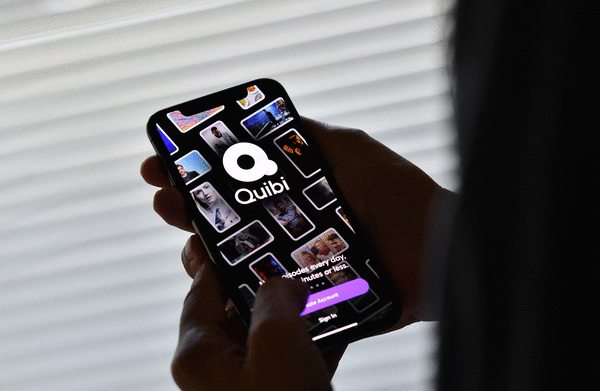
It’s impossible to discuss this trend without mentioning the rise and fall of Quibi. Originally a portmanteau for “quick bites,” its name has since become shorthand for a high-profile, expensive failure in the tech and entertainment industries. The platform raised $1.8 billion to bring Hollywood-grade production to vertical video before shuttering less than a year after its launch in 2020.
Many still cite Quibi as evidence this microdrama trend won’t last. Others have blamed the timing of its launch, coinciding with the pandemic, for its failure (an odd defense given the lockdowns helped the format take off in China). The real lesson is that you don’t need multimillion-dollar budgets for something viewers watch while scrolling at the dentist’s office, in the bathroom, or, increasingly, while waiting for an AI tool to respond.
Quibi began too-big-not-to-fail. China’s challengers reversed the model, growing audiences with modest budgets and no stars, echoing the way the creator economy was built on Alphabet Inc.’s YouTube and TikTok.
Globally, most of the market share has coalesced around five Chinese-origin players you’ve probably never heard of — ReelShort, DramaBox, DramaWave, NetShort and GoodShort — with some 300 smaller apps behind them, according to Media Partners Asia. Like with many tech-adjacent industries in China, brutal competition has led to rapid iteration. Domestic microdrama producers essentially use a “spray and pray” method, churning out 3,000 new productions a month, according to a Peking University report.
It seems to be working. Users spend around two hours a day on them, a trade group said last year. Average daily time spent internationally hit 25 minutes this April, up 85% from January last year, according to Sensor Tower. Traditional streaming services remained broadly flat at around 35 minutes.
AI is emerging as the sector’s other secret weapon. While there has been a lot of trepidation about its rise in Hollywood, microdrama studios have embraced the technology for everything from subtitling, script-writing and, increasingly, creating entire shows. As Western labs shifted resources to coding, Chinese AI video generators continue to dominate global benchmarks.
The Peking researchers estimated the industry supported more than 2 million jobs last year. That combination of heavy AI adoption and rapid job creation makes the nascent sector the ultimate real-time case study for whether the technology will democratize creativity and expand employment (as its proponents say) or hollow it out (what we’re likely to see in the near term).
But Sora, OpenAI’s short-lived AI video platform-cum-TikTok clone might offer another warning. Quibi may have spent too much on production, but Sora went in the opposite direction. It let users generate pure brainrot, often lacking even the pretense of a storyline. Microdrama producers relying entirely on AI will find audiences are already sick of slop. AI is better used as a tool than a substitute for storytellers.
China’s approach carries risks. Becoming too big could put a TikTok-like target on these apps. Many have flown under the regulatory radar so far (how much harm can binging on Duke With Benefits really do?). But that could change if policymakers view this latest soft power lever as a threat. And then there’s looming labor uncertainties for the U.S., as many of these productions employ non-union workers.
It’s easy to dismiss this trend as too mind-numbing to last. But many (myself included) initially felt the same about the lip-syncing videos on TikTok in the early days. Eventually, U.S. tech firms were forced to copy the playbook in the form of Meta Platforms Inc.’s Instagram Reels and YouTube Shorts.
For better or worse, microdramas can no longer be dismissed as a passing fad. The only thing shrinking faster than our attention spans might be America’s window to compete.
____
This column reflects the personal views of the author and does not necessarily reflect the opinion of the editorial board or Bloomberg LP and its owners.
Catherine Thorbecke is a Bloomberg Opinion columnist covering Asia tech. Previously she was a tech reporter at CNN and ABC News.
©2026 Bloomberg L.P. Visit bloomberg.com/opinion. Distributed by Tribune Content Agency, LLC.











Comments