Movie review: 'The Uprising' a medieval revolt that speaks to our modern moment
Published in Entertainment News
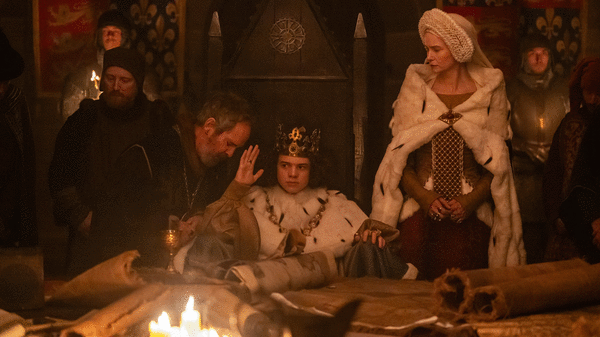
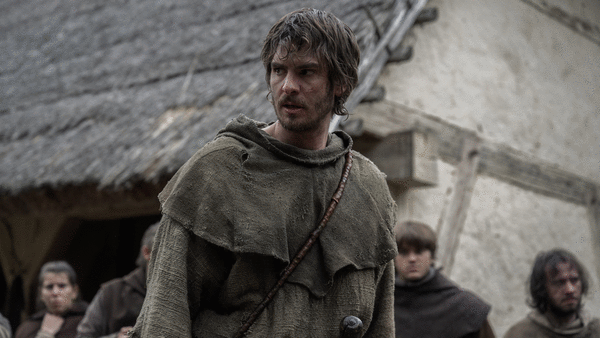


Filmmaker Paul Greengrass is often associated with a cinematic aesthetic colloquially known as “shaky cam” — hand-held cinematography enabled by lightweight digital cameras that function a lot like another character in the room, on foot, at eye-level, responding and reacting to action and dialogue the way a person would.
It’s a style that has served him well in modern action thrillers like his installments of the “Bourne” franchise, and films depicting recent real-world events like “Captain Phillips” and “The Lost Bus.” Now, Greengrass applies his signature style to the Middle Ages — can shaky cam work in a medieval movie?
It might seem odd, but it’s a brilliant creative choice when considering that while “The Uprising” is technically about the 1381 Peasants' Revolt in England, that’s not really what it’s about. It’s about right now.
The shaky cam is intended to jolt us into that awareness. When we pick up with our protagonist, a pathetic Ploughman (Andrew Garfield) living a grief-filled and wretched existence, a plague has wiped out half the population. A small group of men hoard wealth and resources, while the peasant class is heavily taxed, laws brutally enforced. As Greengrass lays out the bare facts of this situation with a cinematic style that’s more news documentary than stuffy period piece, the parallels to our own current situation are laid bare.
“The Uprising,” which Greengrass wrote and directed, is told in a fairly simple fashion, with an emphasis on visual storytelling and visceral sensation and immediacy (the disparate English accents are also lost in the melee of the mob. All we need to know is that the council advising the 14-year-old King Richard II (Woody Norman) conspires while the young king prays and his mother (Katherine Waterston) glowers. Outside, a bloodthirsty mob armed with farm tools marches on London, led in part by the Ploughman, who started his own local uprising when he fought back against the taxman. He joins forces with Wat Tyler (Cosmo Jarvis), a former soldier, and John Ball (Jamie Bell), a priest deemed heretic, as the crowd demands an audience with the king.
As the chaos unfolds, Greengrass doesn’t pontificate on the morality of these events, and in fact, maintains a rather neutral stance on it for most of the film, withholding judgment. A revolution is not right or wrong for most of “The Uprising,” it is simply inevitable under the conditions the film presents.
The Ploughman wants to play by the rules, but it’s how the revolt plays out that radicalizes him. While Greengrass shows us the uprising in all its messy confusion as the logical outcome of oppression, by following our Ploughman protagonist as he witnesses treachery and deceit, Greengrass ultimately arrives at the belief, as our Ploughman does, that revolution is necessary, even in failure, and that freedom is worth more than anything.
The opening and closing of “The Uprising” are bracing and stark in their storytelling — the middle is a bit mushy and confusing. But it’s the performances that carry us through. Garfield, sensitive and earthy, is our bellwether as the events descend into bloody carnage dictated by muddled agendas. When he turns, we turn, and the anguish that Garfield wordlessly conveys is our compass.
Greengrass surrounds Garfield with actors who deliver bigger performances, like Jarvis as the brutish but shrewd Tyler, and Bell as the fervent Ball. Thomasin McKenzie plays a young woman, Alyce, steeped in her own trauma and loss, who attaches herself to the Ploughman, and her ability to express wide-eyed, barely contained hysteria and fear is unmatched. Young Norman is riveting as the increasingly dastardly king.
The Peasant’s Revolt of 1381 is a fascinating moment, because it’s a time when the notion of democracy wasn’t even a twinkle in a feudal servant’s eye. The mob’s actions are frustrating because they’re both religiously bound to the king, whom they believe is an emissary of God, and desperate to change their day-to-day existence. When those two instincts collide, it’s bound to be complex and conflicting, and Greengrass delivers that with a boots-on-the-ground style with a sense of spontaneity and fervor.
The murkiness of it all clarifies by the end of the film, not just in terms of its heroes, villains and message, but Greengrass also situates this story within a recognizable cinematic and storytelling history. There’s a thrill as it all comes together. Greengrass might be making a big swing (of the scythe), but his blade finds its target nevertheless.
———
'THE UPRISING'
3 stars (out of 4)
MPA rating: R (for violence/bloody images)
Running time: 2:07
How to watch: In theaters Sept. 11
———
©2026 Tribune Content Agency, LLC









Comments