Movie review: Fancy trappings can't hide the emptiness of 'Victorian Psycho'
Published in Entertainment News
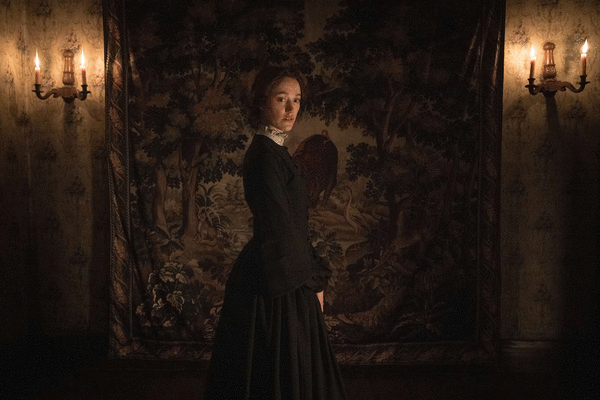
If only there was more to “Victorian Psycho” than just a silly play on words. Based on a 2025 novel by Virginia Feito, the premise is a gender- and era-swapped take on the iconic book and movie “American Psycho.” Both stories imagine a bloody serial killer tale through the eyes of the unrepentant perpetrator: one, a young man in the finance world of 1980s New York City, the other a governess working for an aristocratic family in Victorian England.
They are equally bloody fables, but the American film is a fizzy pop satire about status and masculinity, while the girly version, adapted by author Feito, tries to tackle the same class and gender issues, but struggles to find its own reason for existing.
Director Zachary Wigon certainly attempts to distract the audience from the emptiness of the text. Wigon over-indexes on style, with the cinematography by Nico Aguilar littered with repeated whip-pans and swift up-and-down tilts. The intended effect is a quirky, bold aesthetic, and ostensibly it’s to align the audience with the unusual perspective of our protagonist, but that goes out the window when we get shots from the POV of a disembodied ear, and an infant in a carriage. It becomes bossy, intrusive and irritating in its insistence and inconsistence.
The film’s wacky camerawork announces itself with a crooked opening shot in which our titular psycho introduces herself to us. She is Winifred Notty (Maika Monroe), and she’s the “sanest person” she’s ever met, she declares from the backseat of a carriage delivering her to Ensor House to begin employment with the wealthy Pounds family. OK girl, whatever you say.
“Victorian Psycho” spends all of its energy declaring “she’s SO crazy!” in a way that becomes profoundly grating, particularly in the repetitive stylistic tics of which Wigon is so fond, and without a whisper of coherent character motivation.
Why is it remarkable that she’s crazy and violent? Because she’s a small woman? Because everyone speaks in “thee” and “thou”? Because she says scary things to small children, including Jacobi Jupe (who played Hamnet)? Despite reams and reams of interior monologue as narration, there’s no cogent reason for Winifred’s homicidal urges until an eleventh hour reveal that lands with a thud, far past the point at which it would have had any significant impact on the story or the character.
This is a role that “elevated horror” scream queen Monroe (“Longlegs,” “It Follows”) could perform in her sleep, as she twists her face into disturbing expressions, delivering lines like “Fred is the name of the demon that lives inside me,” to her young charge, Andrew (Jupe). Her co-star Thomasin McKenzie, playing the innocent nursemaid Miss Lamb, could also pull this off with little to no effort on her part.
To be sure, the performances are entertaining, including Jupe, and Ruth Wilson and Jason Isaacs, who play the Pounds parents. Mrs. Pounds is insecure and jealous; Mr. Pounds is a strange and lecherous man, descended from a long line of strange and lecherous nobility. Their comic turns satirize the insular worlds of English landed gentry, but there isn’t much insight other than “get a load of these weird rich people,” a tale as old as time.
As Winifred starts killing to cover up her tracks, she slays herself into a corner. She might be ballsy and bloodthirsty, but it’s too bad that, like the film, she doesn’t have any brains. This whole endeavor is all surface, no interior. Rife with provocative images and gore, the film’s edgy impulses aren’t rooted in anything other than the ravings of a madwoman — a psycho is not a reliable narrator after all.
The climax is when Wigon really gets in his own way. Banished from the home for her creepy behavior and uncomfortable revelations, Winifred returns. Yay, the big bloodbath, the Grand Guignol — if that’s what we’re doing here, let’s get on with it. Instead, Wigon intercuts Winifred’s big moment with a confounding fantasy sequence, draining all its impact.
It’s indicative of the rest of the film, which isn’t funny, or suspenseful, or scary, because there’s no earnestness, just irony. It’s a slasher film ironically set in a fastidious manor home ruled by strict decorum, ironically following the young woman who does the slashing. The movie is all premise, which is too clever by half. The actors do fine work. Wigon throws every single trick in his bag at the material. But no amount of cutesy camera flourishes can make us care about this story if there’s nothing behind the ornate surface.
———
'VICTORIAN PSYCHO'
1.5 stars (out of 4)
MPA rating: R (for strong bloody violence and brief sexual material)
Running time: 1:42
How to watch: In theaters Nov. 13
———
©2026 Tribune Content Agency, LLC










Comments