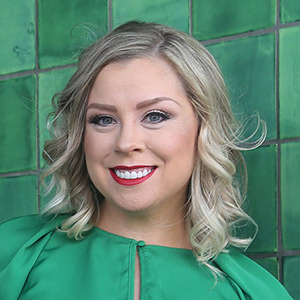
How a Writer Overcame Delusions in Postpartum Psychosis
When Ayana Lage got pregnant, she prepared for the worst. She'd struggled with mental health and knew depression could be lying in wait.
She didn't expect to feel exhilarated after the birth.
"I'm so happy," recalled Lage, 32. "I'm doing amazing. I'm thriving, and I don't feel like I need to sleep. I literally just feel incredible."
Then came mood swings, curling up in a ball, crying. She'd ping-pong back and stay up all night on Instagram, where she had a following of tens of thousands from her work as a journalist-turned-social media content creator.
Eventually, the woman who grew up in a Pentecostal church started to hear something she had always longed for -- the voice of God.
So began her journey through postpartum psychosis, a condition experienced by an estimated 1 to 2 of 1,000 people but far less discussed than other maternal afflictions.
Lage, who lives in the Tampa Bay area of Florida with her husband, Vagner, and their two children, has chronicled her story in her brave and elegantly told new book, "Missing Me: A Memoir of Postpartum Psychosis." I sat down with Lage to catch up. This interview has been edited for length and clarity.
(SET BOLD)Can you take me through your experience?(END BOLD)
I was prepared for postpartum depression. I knew the signs. I was bracing myself after giving birth for this crash because of hormones and my mental health history. I actually had the opposite happen. I felt really, really happy and light and funny -- like really funny. And I just felt like I was on top of the world. I was riding that high and thinking, you know, I could have 10 more kids.
When you're a new mother, when you've just given birth, you're going to behave in ways that you usually wouldn't. You're sleep-deprived. You're, in my case, recovering from a C-section on pain meds. You've got all of these hormonal changes happening. I think that people made a lot of room for me to act differently, so it took a while before it became a concern.
My husband started to feel like something could be wrong and started to talk to my parents and my postpartum doula and say, OK, she's spending a lot of time on her phone, to the point that she doesn't seem to care about the baby. And she is not sleeping at all. He ends up reaching out to my psychiatrist.
My mood shifts to paranoia. I start to feel as if I can't trust him. I can't trust anyone. I'm the only one that my baby is safe around. I get very irritable, snapping at everyone. I am on the internet very much like, "I am setting boundaries and taking control."
We reached a point where he ended up taking my phone and changing the passcode because I was so belligerent and so over the top. The last straw was that I had a moment where I went on Instagram and pretended to be him and typed out this long missive about people not leaving me alone and not respecting boundaries. And he deleted it, but by then, you know, thousands of people had seen it and liked it.
This is August 2020. No one wants me to go to the hospital because of the pandemic. They were just watching me very closely, watching the baby very closely. And hoping that whatever was going on could be fixed with just, like, me taking my meds and getting sleep. That was a big focus. She'll wake up, and she'll be herself.
But then, unfortunately, things deteriorated, and I started to hear messages from what I, you know, called God.
(SET BOLD)This voice made you terrified and elated. Can you put that in context?(END BOLD)
I grew up in a Pentecostal church. The voice of God is a huge factor and force. I'd always wanted to hear from God. I'd always wanted God to heal me, to tell me secrets, to show me things the way that I saw it happen in church, and I never really got that. Into adulthood, I'd moved away from that kind of faith, but I think there was still a small part of me that thought, man, that'd be really cool if that was what happened to me. A miracle would be pretty cool.
(SET BOLD)And what was the voice telling you?(END BOLD)
A whole lot. The first word that I hear from God is that I'm going to write a book one day. I'm going to be an author. It's going to be a successful book. Everyone in the world is going to read it. It's going to be more popular than the Bible. I was going to rewrite the Bible. My daughter was the second coming of Jesus. My family was trying to harm her, and she wasn't safe around them. Once I got to the hospital, the doctors and nurses were trying to kill me and poison me, and they were running experiments on us. The biggest constant throughout was that I was someone special, and no one else in the world knew God like I did.
(SET BOLD)How did you begin to pull out of this?(END BOLD)
The only reason that I really emerged from it in the hospital was because of antipsychotics. They just kept upping my dose of certain medications until I started to show improvement. It worked very, very quickly. The delusions stopped nearly immediately once the medication was at the effective point.
(SET BOLD)How have you seen the conversation around postpartum psychosis grow in our culture?(END BOLD)
It's easy to say, OK, a parent hurts their child, they're evil. They deserve to be thrown under the jail and rot for life. But when you look at the facts of postpartum psychosis, many of the women who harm their children are doing so because they think that they are helping them.
Those are conversations that I'm seeing happen more and more, which is really encouraging. People are warming up to the idea of, OK, this is more complicated than it might seem.
(SET BOLD)How has this event changed your relationship with social media?(END BOLD)
I still like to have fun on the internet, but I'm way more guarded about the information that I share. Which if anyone knows me, they might be thinking, no, you're not. Because I still share a lot. But I think that for me, my mindset around it is different. And if I'm having a bad day or feeling off, I throw my phone and don't touch it because I still have this pervasive fear of, I'm going to get on the internet and embarrass myself. One of the biggest regrets that I have is the fact that I was so vocal on social media about all the things I was feeling.
(SET BOLD)It's interesting that your particular psychosis manifested with religion and social media, being an influencer. Does a psychotic event reach into your personal roots and feed on it?(END BOLD)
I think so. I was almost a caricature of myself. The only people who were seriously worried about me were people who knew me very well. I had two friends who reached out. One reached out to my mother, one reached out to my husband. And then my doula had also expressed concerns.
But for the most part, I was feeding off this attention. I was sharing all of these things, and I was very in your face and a little bit rude and still a little bit funny. And people were loving it, you know? I was getting a ton of positive feedback from people I knew in real life and complete strangers. It hyped me up in a way that was dangerous.
(SET BOLD)You seem to be working out your faith in real time. Where are you on that journey?(END BOLD)
I call myself loosely religious at this point. I don't know. I still go to church. I still believe in God, but it's never going to be what it once was. I'm uncomfortable with prayer because it reminds me of the voices and hearing from God. The Bible is difficult for me because I tried to rewrite it. I still think that there's something there for me. But it's a little bit more distant than it was.
(SET BOLD)If somebody wants to share their experience, what's your advice?(END BOLD)
I started the conversation by talking to people that I knew and loved in real life before I ever talked to the internet about it or did interviews or wrote about it publicly. I had these awkward moments like, "Hey, you know when I fell off the face of the earth after having a baby and then emerged, and something had happened but it wasn't clear, and obviously you can't ask?"
I think that those conversations enabled me to start talking about it more widely. It doesn't have to be like a splashy, national news, big thing that you're doing. Even if you are raising awareness among the people that you know in your life, on your Facebook feed, on your Instagram feed, whatever, it's work that needs to be done.
========
Stephanie Hayes is a columnist at the Tampa Bay Times in Florida. Follow her at @stephrhayes on Instagram.
----
Copyright 2026 Creators Syndicate Inc.






Comments