No family history? Under 40? Why common breast cancer myths put you at risk
Published in Health & Fitness
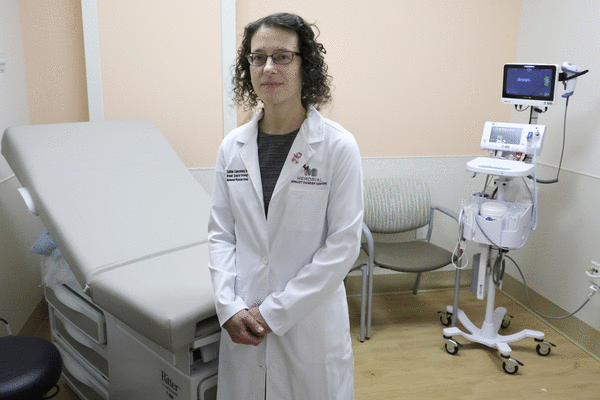
FT. LAUDERDALE, Fla. -- Having no family history does not mean that someone can’t still get breast cancer, nor does having a double mastectomy.
While widespread awareness of breast cancer has helped save lives, persistent myths about the disease continue to cause dangerous delays in screening, treatment and follow-up. From misjudging age-related risk to confusion over dense breast tissue and screening guidelines, separating fact from fiction empowers individuals to make informed decisions about their health.
Esther Ozeryansky, a breast surgical oncologist at Memorial Healthcare System, often encounters a patient in disbelief when she faces breast cancer for the second time or is diagnosed even though she may have no family history of the disease.
With breast cancer awareness in the spotlight this month, Ozeryansky, a surgeon, and Dr. Tammy Adar, manager of the hereditary cancer program with Memorial Healthcare System, address the misconceptions about the disease.
Myth: Cancer in one breast can move to the other
“Breast cancer does not move from the right breast to the left breast. If you have breast cancer, it will travel from the breast to the lymph nodes in the armpit, then it spreads to other parts of the body. If you develop breast cancer in the other breast, that’s a completely new, different breast cancer,” Ozeryansky said.
Myth: The disease is only found through a lump
“If breast cancer metastasizes to the bone, then patients can have bone pain as a symptom of metastatic breast cancer,” Ozeryansky said. “Bone pain can occur anywhere in the body, including the hip bone or the back.”
Myth: Breast cancer is hereditary
The vast majority of women with breast cancer will not have a genetic mutation, noted Dr. Tammy Adar, a genetic counselor at Memorial Healthcare System. About 85% of patients with breast cancer don’t have any family history, and breast cancer is hereditary only 5% to 15% of the time.
“It is important not to skip out on normal screenings, because everyone has a risk,” she said.
Myth: The only treatments are chemotherapy and radiation
Ozeryansky said many drug trials are ongoing, with new medications approved every year.
“It’s constantly changing,” she said. “New options are constantly coming to market and being incorporated into treatment. It’s a rapidly evolving field.”
Myth: You have to have connections to get into a clinical trial
Most large institutions, like Memorial, have a clinical research department, noted Ozeryansky. “They will have certain clinical trials that are open at that institution, and as long as the patient meets criteria, they can enroll,” she said. “So, if there is a particular trial that a patient is interested in, they can always look to see which institutions are participating in that trial and go to have treatment at that institution.”
Myth: Breast cancer is fatal
“The patients who I used to have to pray for, the ones that I was worried most about, the ones that I thought had the worst prognosis are now more and more likely to have a good outcome and to survive and be completely cured, which I think is incredible,” Ozeryansky said.
Previously, patients with triple-negative breast cancers had few options.
“It was kind of a coin toss whether or not they would respond to the additional chemotherapy that we had,” she said. “And those who didn’t respond usually died of the disease. And now, because of immunotherapy, most of those patients respond very well. As long as it has not spread to other parts of the body, as long as it’s not Stage 4, we consider breast cancer curable.”
Myth: Mammograms can miss breast cancer
“When patients get annual mammograms, they’re most likely to be diagnosed with early-stage breast cancer,” Ozeryansky said.
“There are some odd cases where breast cancer can be very small or not detectable on mammograms or might not even be visible in the breast and spread to lymph nodes and then to other parts of the body. We do see cases like that, but that is rare and unusual,” she said. “The vast majority of women who get yearly mammograms do get diagnosed at early stages.”
Myth: Mastectomies prevent breast cancer
“I think a very prevalent misconception people have about a mastectomy is that it somehow cures breast cancer and eliminates the risk of a future breast cancer. Those are misconceptions,” Ozeryansky said.
Breast cancer can still recur.
Because of that myth, Ozeryansky regularly encounters women who believe removing both breasts is the only way to respond when a lump is diagnosed as malignant.
“Why would somebody choose to do a bilateral mastectomy when they could choose to do a lump removal? The cancer could come back regardless,” she said. “But they’re very worried, and they want that, no matter how many times I reassure them that the survival rate is the same.”
“The only time I will encourage patients to consider a bilateral mastectomy is when they have a BRCA mutation because their risk of a breast cancer on the other side is actually quite high,” she said. (BRCA are breast cancer genes that act as tumor suppressors.)
Mammograms are not recommended after a mastectomy. Ozeryansky urges women who have had a double mastectomy to be vigilant about regular follow-up exams.
Myth: Breast cancer is completely random
Ozeryansky says besides a genetic risk, additional factors put women at risk for breast cancer.
“Obesity is one because most breast cancer is driven by estrogen, and our peripheral fat cells produce estrogen,” she said. “So the more obesity there is, the higher the risk of breast cancer.”
She said the risk is the same for men. “We think of men as not having estrogen, but with obesity they absolutely do have higher estrogen production, and so because of that, obesity in men is also related to increased risk of breast cancer in men,” she said.
She notes other factors add risk, too: getting your first period at a young age; the combination of hormone replacement therapy, obesity, and alcohol; high alcohol consumption; smoking; and a sedentary lifestyle,
Myth: Those with dense breasts only need mammograms
“Women with dense breast tissue are at higher risk of developing breast cancer,” Ozeryansky said. “So if you have dense breast tissue, your risk of developing breast cancer is increased about twofold. There is an issue with mammograms when it comes to dense breast tissue because it can be difficult to spot breast cancers within the dense breast tissue. So, for women who have dense breast tissue, it is recommended that they have an ultrasound performed in addition to their mammograms.”
Myth: As you age, you don’t need mammograms anymore
“The age cutoff has to do with your own life expectancy, and we have lots of people, especially here in South Florida, who will live into their 90s, and so we should not stop at any specific age,” Ozeryansky said. “It should be when you see that your quality of life is starting to decrease and your life expectancy is five years or less. Then it makes sense to stop those screening mammograms.”
Myth: An all-clear on a test for a BRCA mutation means no further testing
“We’ve had a severe technology shift that happened around 2014, but adoption of that also took a little while,” said Adar, the geneticist. “If you were tested before that, you should be tested again.”
Adar said previously, individuals were tested for fewer gene mutations — typically just BRCA1 and BRCA2. “While those two are the most common ones, there are quite a few other genes out connected to breast cancer that people can have mutations in,” she said.
“If someone has had multi-gene panel testing of about 30 genes or more, usually that person’s going to be good until we get new technology,” she said. “I’m doing panels with between 63 and 85 genes, but you know some gynecologists may only be doing 30 or 40 genes, and that can be fine depending on what the family history is.”
Myth: Knowing your risk won’t help you prevent cancer
Adar said knowing you are at risk for breast cancer allows you to consider preventive measures and earlier and more frequent screenings.
“If we can’t reduce the risk for cancer, we can still catch it early, and being able to catch cancer early is key because the smaller the cancer is, the easier it is to treat,” she said
Myth: Men don’t get breast cancer or have the BRCA gene mutation
Men can and do get breast cancer.
“It’s a misconception that only females can get breast cancer or have mutations to the BRCA gene,” Adar said. “It is a misconception that people can’t pass down hereditary increased risks for breast cancer to their sons, or that things going on on their father’s side don’t matter.”
Adar said it’s worthwhile to get tested when you have a certain famiy history: “A lot of our hereditary breast cancer genes also increase the risk for prostate cancer,” she said. So if a family has a history of prostate cancer, “we’re worried about those same gene mutations for breast cancer.”
©2026 South Florida Sun Sentinel. Visit at sun-sentinel.com. Distributed by Tribune Content Agency, LLC.









Comments