SpaceX knocks out launch as NASA delays Artemis rollback
Published in Science & Technology News
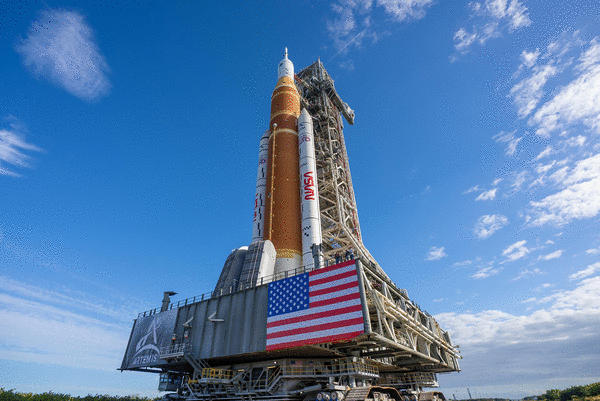
The cold weather didn’t delay SpaceX’s plans to launch another Starlink mission Tuesday, but did delay NASA’s plans to roll back the Artemis II rocket from the launch pad.
A SpaceX Falcon 9 carrying 29 of its internet satellites lifted off from Cape Canaveral Space Force Station’s Space Launch Complex 40 at 6:04 p.m. Eastern time.
The first-stage booster made its 10th trip to space and made a recovery landing downrange in the Atlantic on the droneship Just Read the Instructions.
The launch was the 13th from the Space Coast so far in 2026, with all but one coming from SpaceX. United Launch Alliance flew its Vulcan rocket on a national security mission earlier this month while Blue Origin has yet to launch this year, but is gearing up for the third flight of its New Glenn rocket.
NASA, meanwhile, must delay until at least April its plan to send four astronauts on a lunar fly-by on the Artemis II mission. The Space Launch System rocket topped with the Orion spacecraft is set to be rolled back from Kennedy Space Center’s Launch Pad 39-B to the Vehicle Assembly Building, but is delaying until Wednesday because of high winds and cold temperatures.
Those winds delayed preparations for the roll, which is now set to begin around 9 a.m. Wednesday. The 4-mile trip from pad to the VAB will see the SLS and Orion atop mobile launcher 1 placed on crawler-transporter 2 moving at a maximum speed of 1 mph for what will be about a 12-hour journey.
The need to bring the rocket back to the VAB came after a helium flow issue was found in the rocket’s upper stage, something that cannot be fixed without access to the interim cryogenic propulsion stage that cannot be done at the pad.
“Once back in the VAB, teams will immediately begin work to install platforms to access the area of the helium flow issue,” reads an update on NASA’s website. “Teams also will take advantage of the time in the VAB to replace batteries in the flight termination system and retest it, and replace additional batteries in the upper stage. ”
The problem arose less than a day after NASA had declared it would try for a launch in March coming off a successful wet dress rehearsal.
NASA’s declared target for the Artemis II launch had been no later than April, but had sought to take advantage of February and March windows after beating preparation schedules over the last year.
The February attempt, though, was taken off the board when NASA’s first wet dress rehearsal ran into cryogenic liquid hydrogen leaks into the SLS core stage during tanking. All looked well after a smooth second wet dress rehearsal until the helium flow issue popped up.
-----------
©2026 Orlando Sentinel. Visit at orlandosentinel.com. Distributed by Tribune Content Agency, LLC.






Comments