As Artemis II heads to moon, work gets going on Artemis III
Published in Science & Technology News
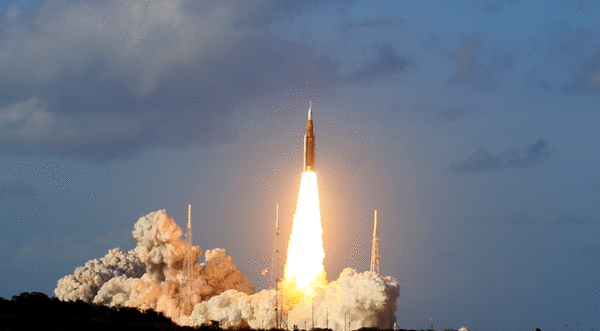
The four astronauts of the Artemis II mission punched their moon ticket on Thursday afternoon — but back at Kennedy Space Center in Florida, teams are already refocusing on the launch of Artemis III next year.
NASA astronauts Reid Wiseman, Victor Glover and Christina Koch as well as Canadian Space Agency astronaut Jeremy Hansen were given the OK for the translunar injection burn that will send them on a lunar fly-by, bringing humans into deep space for the first time since the Apollo 17 moon landing mission of 1972.
While the quartet have the rest of their 10-day mission to complete, with a targeted splashdown in the Pacific Ocean on April 10, teams at Kennedy Space Center’s Launch Pad 39-B began their first look at how much damage the launch site took after the Space Launch System rocket blasted off on Wednesday.
The SLS is the most powerful rocket to ever launch to orbit, producing 8.8 million pounds of thrust on liftoff. Its only-ever previous launch, the Artemis I mission in 2022, handed out severe damage to the mobile launcher, or ML1, that required significant repairs.
Directly after Wednesday’s launch, Lori Glaze, acting associate administrator for NASA’s Exploration Systems Development Mission Directorate, said imagery of the site seemed promising. Teams headed out to the pad after the hazardous conditions were given the all clear.
“We haven’t seen evidence of things like after Artemis I, (when) the elevator doors were blown off. We haven’t seen that,” she said.
NASA has yet to update further conditions, but Glaze detailed some of the things that did work on Artemis II that were problematic during the 2022 launch.
“One of the issues we had was that the water that was supposed to be spraying down the launch pad ... that didn’t happen (on Artemis I). We saw a lot of corrosion,” she said, but for this launch, “the water was working, so things were getting washed down.”
Teams will still remove parts from ML1 to get separate washdowns and avoid corrosion.
“We’re optimistic, but we’ve got to get out to the pad. We’ve got to look. We did a lot of changes after Artemis I, trying to harden the system so that we can turn it around faster,” she said.
One of the options NASA has now for any issues with ML1 is to pluck items off of the mobile launcher 2, or ML2, the $1 billion-plus launch tower that had been under construction adjacent to Kennedy Space Center’s Vehicle Assembly Building for the last couple of years.
Work on ML2, though, has stopped as the tower was rendered extraneous after NASA Administrator Jared Isaacman announced the agency was stopping work on a larger version of the SLS rocket for which the tower was built.
“We have issued a stop work order for mobile launcher 2,” said Shawn Quinn, program manager for NASA’s Exploration Ground Systems group based at Kennedy Space Center. “We’ve pivoted the team to be begin removing some of the hardware that’s common to mobile launcher 1 that we can use as critical spares.”
Quinn said some of the items used on the towers require parts that take a long time to procure, so having ML2 as a donor tower helps.
“They’re hard to build, and they will be put to good use for future Artemis missions for supporting mobile launcher 1,” he said.
ML1 has to be ready to go before NASA can begin any stacking of the Artemis III rocket in the VAB. First up will be the segments for the two solid rocket boosters, followed by the core stage, upper stage and Orion spacecraft.
Chris Cianciola, deputy manager for the SLS program, said the booster segments “are being loaded on the rail cars, and they’re ready for shipment.”
They would arrive this month while the Artemis III core stage’s engine section is already in the VAB in High Bay 2 while the top four-fifths of the core stage are at NASA’s Michoud Assembly Facility in New Orleans will head for Kennedy Space Center at the end of the month.
If NASA elects to use the interim cryogenic propulsion system upper stage on Artemis III, that’s in storage at United Launch Alliance’s facilities in Cape Canaveral already. Meanwhile, the adapters to connect the stages and Orion are “in storage, waiting on the phone call to for assembly. So we’re in really good shape for Artemis III.”
As far as the next Orion spacecraft goes, it too is already at Kennedy Space Center along with the European Service Module that arrived last December, said Orion Program Manager Howard Hu.
“We’ve been making good progress,” he said. “On the crew module side, we’re wrapping up the final big installation. So the heat shield is going getting attached to the crew module this month, as well as a side hatch, and it’s going to go through its paces for testing as an individual element.”
The crew module and service module will be put together next summer and would be on plan to support launch soon after.
Isaacman’s new Artemis mission plan calls for the next flight to be to low-Earth orbit, targeting mid 2027. For that mission, Orion will dock with one or both of the lunar landers being developed. After that, the Artemis IV mission would aim for a lunar landing in early 2028 with a second lunar landing potentially flying in late 2028.
That schedule needs a lot of parts to fall into place correctly, but Isaacman’s plan is pushing for as short as a 10-month turnaround between launches as NASA seeks to use all of the SLS rockets in flow and the pivot to heavy lift rockets from commercial providers like SpaceX and Blue Origin.
But the SLS can’t do anything until the mobile launcher is good to go,
“We do anticipate there will be some items that will need to be replaced,” Glaze said. “It’s a pretty violent environment, but we’re hopeful that that’s minimized.”
_____
©2026 Orlando Sentinel. Visit at orlandosentinel.com. Distributed by Tribune Content Agency, LLC.






Comments