Editorial: Anti-diversity legislation threatens to Make Florida Ugly Again
Published in Op Eds
There was a time in Florida when diversity, equity and inclusion (DEI) were considered to be good things. When it was OK to celebrate the state’s vibrant array of cultures. When parents and teachers raised children to believe that their futures mattered; when leaders transcended ideology to make communities stronger and better-prepared to stand together in calamitous times. When government and business leaders embraced the idea that this state was strongest when everyone had a chance to climb the ladder of success, despite their skin color, accent, faith or gender identity.
But somewhere after the election of former Gov. Rick Scott, things shifted. Florida leaders decided that people were being just a little too accepting of others’ differences, a little too eager to make sure all people had access to opportunities that led to prosperity for their communities, their employers and themselves.
Ever since, they’ve twisted themselves into pretzel knots trying to find ways to punish so-called DEI policies, passing cruel legislation that, in years to come, will weaken Florida’s communities, its business climate and its sense of well-being.
Attacks on celebration
The latest anti-DEI attack (House Bill 1001/Senate Bill 1134) to darken the state Legislature’s doors was envisioned, at least partially, as an official antidote to joy. It’s a sprawling, vague mess that would undermine (and perhaps eliminate) vibrant expressions of cultural celebration across the state and threaten the ability of local communities to contribute to events as diverse as Miami’s Calle Ocho festival, Orlando’s all-embracing Come Out With Pride parade or Black History Month celebrations across the state..
Orlando officials have more reason than most to fear. This year marks the 10th anniversary of the Pulse nightclub shooting, which left 49 people dead and 53 more injured. The city and county are funding a memorial at the site. The sponsor of the Senate bill says that the memorial won’t be impacted by this legislation, because the Pulse site is designated as a national memorial, and the bill explicitly excludes those sites from its prohibitions on local spending.
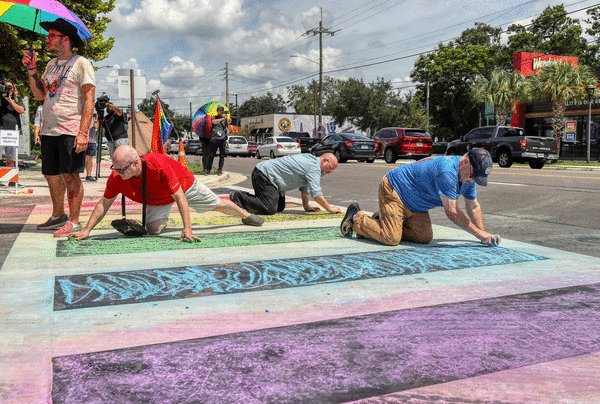
But in this day and age, federal policy can change with the wind — after all, the colorful road crossing adjacent to the Pulse site was declared compliant with state and federal rules just months before U.S. Secretary of Transportation Sean Duffy went on a social-media rampage against “rainbow crosswalks.” Within weeks, state workers came in the dead of night and stripped the crosswalk of its colors.
It gets worse. The language of SB 1134 and HB 1001 is so broad and restrictive that it could crush attempts by cities to rebuild shattered neighborhoods by using heritage to spur action. It would definitely hinder, and perhaps eradicate, programs that encourage cities and counties to look for economic partners across diverse communities, or roundtables intended to help people of differing backgrounds to understand each other and work together.
And it would, without question, threaten the right of city and county residents to choose local leaders who best represent their own values. The punishment for violating this broad, unpredictable bill could be removal from office.
Broad and vague
Don’t take our word for it. Read the language for yourself. The official House analysis of the legislation starts with this:
“The bill prohibits counties and municipalities from: Funding, promoting, or taking any official action, such as the adoption or enforcement of ordinances, resolutions, rules, regulations, programs, or policies, relating to diversity, equity, and inclusion. (It also prohibits) spending any funds, regardless of source, for diversity, equity, and inclusion offices and official events.”
Now, start thinking about how far this policy could be stretched by those who are seeking to make mischief — or just make money — from suing local governments perceived to violate these rules. That’s right, this bill will be a bonanza for bottom-feeding trial attorneys ready to dive onto any action that even acknowledges a community’s cultural heritage, celebrates LGBTQ Floridians or celebrates the erasure of racial boundaries.
Maybe we need an amendment to change the legislation’s name to the “Willis McCall Celebration Act,” after the notoriously racist, segregationist Lake County sheriff who is directly or indirectly connected to multiple historic acts of bigotry-inspired violence across Central Florida.
In 2016, the town of Groveland and Lake County government officially apologized to the survivors of the Groveland Four, a group of young men who were blamed for the rape of a woman in 1949. One of the suspects was hunted and killed soon after the alleged crime; Two others were shot personally by McCall in 1951, as he was transporting them for trial.
Would those apologies count as an “official act” that would be banned by the legislation? How about the 2020 apology, by the city of Ocoee, for the 1920 reign of violence visited on the city’s Black section in what has been referred to as the bloodiest election in the nation’s history?
This year’s anti-DEI legislation is well on its way to passage. It could clear the Senate as soon as Wednesday. And if it becomes law, it could cast a lasting stain on Florida’s reputation, its identity as a welcoming place and even its economy. Rejecting it is the only sensible choice. We only hope lawmakers open their eyes in time.
_____
©2026 Orlando Sentinel. Visit at orlandosentinel.com. Distributed by Tribune Content Agency, LLC.



















































Comments