Analysis: 'De-escalate': Trump team's moves suggest it's not part of the plan
Published in Political News
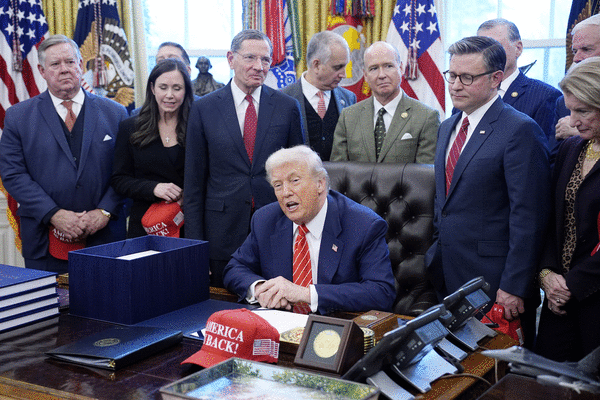
WASHINGTON — President Donald Trump recently used the term “de-escalate,” but on a number of hot-button issues, all he and his team have done in recent days is the opposite.
From videos showing ongoing aggressive actions by federal immigration enforcement agents, to Trump’s tough talk on nationalizing elections in the face of some GOP pushback, to his defiance about being prominently featured in the Jeffrey Epstein files, Trump 2.0 has continued to mash the gas pedal.
Despite one media outlet’s search that discovered more than 5,300 Epstein files that mention Trump, first lady Melania Trump, his Mar-a-Lago estate and other related phrases, Trump on Tuesday remained dismissive and denied wrongdoing, saying flatly that “we have other things to do because that whole thing has turned out … nothing on me.”
While Democratic lawmakers and even some Republicans have advised Trump to show more restraint ahead of November’s crucial midterm elections, the president’s and his administration’s actions suggest “de-escalate” is not really in Trump’s vocabulary or playbook.
Take his Tuesday Oval Office response when asked about his declaration a day earlier during a radio interview that elections should be federalized in 15 unnamed states. In the latest bold statement of his second term, Trump declared a state is merely an “agent” of the federal government when it comes to administering elections, and he called on Congress to act.
“I think the people behind me should do something about it” when there are improper elections, Trump said, surrounded by Republican lawmakers there to watch him sign a multi-agency spending package.
Notably, Trump did not present evidence of a single fraudulent election, nor did he note that the Constitution handed states the power to administer their own elections.
Still, the all-gas-no-brakes chief executive cited Detroit, Philadelphia and Atlanta as places where “horrible corruption on elections” happened, adding: “If they can’t count the votes, legally and honestly, someone else should take over.” Trump again presented no evidence.
White House press secretary Karoline Leavitt earlier Tuesday signaled her boss would continue his elections-related efforts as the clock ticks toward November’s midterms.
“I don’t think any rational person who’s being honest with themselves would disagree with the idea of requiring citizens of this country to present an ID before casting a ballot in a federal election, or, frankly, in any election, and that’s something the president wants to see happen,” she said during a gaggle with reporters outside the West Wing.
“The president believes in the United States Constitution,” she claimed. “However, he believes there has, obviously, been a lot of fraud and irregularities that have taken place in American elections.”
But Robert Levy, chairman emeritus of the libertarian-leaning Cato Institute, recently wrote for the think tank that any president has limited legal powers on elections.
“The president plans to withhold grants to states that don’t require proof of citizenship. Those grants come from the Election Assistance Commission, which is an independent agency created by Congress to improve voting administration. Under current law, Trump has limited authority — only to appoint commission members. His proposal to deny funds is unlawful,” Levy wrote.
And on Trump’s push to limit the counting of some mail-in ballots, he added: “Congress, not the president, can specify the time of federal elections — including any restrictions on mail-in ballots.”
‘De-escalate a little bit’
But in its actions, the administration has shown no signs of slowing down.
Leavitt did not mention potential foreign-based threats to U.S. elections when asked why Trump sent Director of National Intelligence Tulsi Gabbard, a former Democratic lawmaker, to Georgia to oversee a federal raid on a voting facility.
“Tulsi Gabbard has been tapped by the president of the United States to oversee the sanctity and the security of our American elections. She’s working directly alongside the FBI Director [Kash] Patel,” Leavitt told reporters. “This is a coordinated, whole-of-government effort to ensure that our elections, again, are fair and transparent moving forward.
“I don’t see anything wrong with the president tasking a Cabinet member to pursue an issue that most people want to see solved,” she added, defending the president’s aggressive elections-related moves. “Maybe you don’t, but I know many Americans do want to make sure our elections are protected.”
A few hours later, Trump sent a clear signal about his intentions.
“The federal government should get involved,” he said, again referring to alleged election fraud in blue states without providing evidence. “These are agents of the federal government to count the votes.”
Trump first used the term “de-escalate” on Jan. 27 during a midterms campaign swing through Iowa as he spoke with Fox News afternoon anchor and conservative podcaster Will Cain.
“And that’s all working out. You know, we have Tom Homan there now. We put him in there, he’s great,” he said of his border czar taking over federal immigration enforcement operations in Minneapolis after a government agent killed a second American citizen. And they met with the governor, the mayor, everybody else, and we’re going to de-escalate a little bit.”
But then came a telling qualifier in a second term that has been defined by Trump and his most-MAGA of lieutenants deploying rhetorical and legal bulldozers to aggressively move aside or power through laws and governance norms.
“But I will tell you, you look at the numbers, they’re doing better than they’ve done in many years because we took thousands of criminals out of Minnesota,” Trump added.
‘Don’t need guardrails’
Cain asked about installing guardrails around his mass deportation policy and on-the-ground tactics being used by federal agents, who often operate masked and without identification. Trump offered more clues about his true intentions.
“No, I don’t need guardrails, I don’t want guardrails,” he said. “Guardrails would hurt us.”
Such moves by the second Trump administration have not surprised one longtime presidential observer, who also has studied the 37th president.
“Richard Nixon is a comparative case by virtue of his violation of norms, traditions, laws and the Constitution — especially in his Watergate actions — but also unsuccessfully fulfilling his campaign pledge to end a war (Vietnam), and his anti-press activities,” Barbara Perry, a presidential historian at the University of Virginia’s Miller Center, said in an email.
“Nixon had his ‘enemies list’ and prior restraint of the Pentagon Papers, which the Supreme Court overturned as a violation of the First Amendment’s freedom of the press,” Perry added. “Trump may soon discover his tariff policies will be deemed unconstitutional by the Supreme Court. … Using the Justice Department to prosecute and threaten Trump’s opposition — James Comey, Latisha James, John Bolton, etc. — goes even further than Nixon’s enemies list.”
White House aides, and even Trump himself, often dismiss such comparisons. Instead, the showman in chief prefers to engineer ones that are much more palatable to his populist-conservative base.
On Tuesday afternoon, Trump asked Senate Budget Committee Chair Lindsey Graham, a staunch ally and sometimes-golfing partner, to rate his first year back in office. Graham took a step toward the Resolute Desk behind which Trump sat, holding court.
The South Carolina Republican, holding a red “Make America Great Again” ballcap, enthusiastically offered his assessment: “Reagan Plus.”
_____
—Victor Feldman contributed to this report.
©2026 CQ-Roll Call, Inc., All Rights Reserved. Visit cqrollcall.com. Distributed by Tribune Content Agency, LLC.













































Comments