Voter ID bill up next in the House, with Senate future uncertain
Published in Political News
WASHINGTON — As Democrats blast a voter ID proposal touted by President Donald Trump, congressional Republicans are trying to smooth out their own internal disagreements over how far they should go — and whether to tighten federal control over elections in the first place.
With a bill known as the SAVE America Act headed to the House floor this week, GOP members went back and forth over some of its provisions, like whether they wanted to see it take effect before or after this year’s midterm elections.
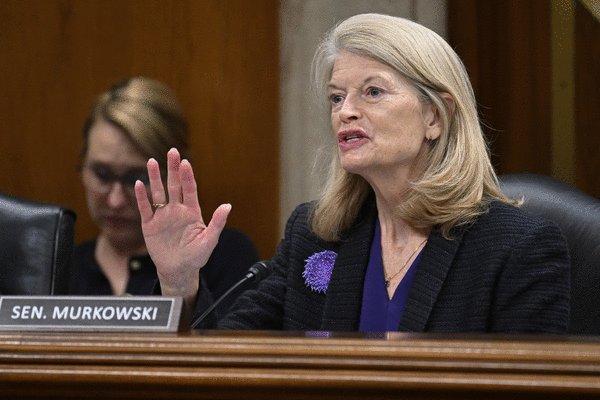
And on the Senate side, Sen. Lisa Murkowski, R-Alaska, became one of a handful of Republicans who have raised constitutional concerns and signaled they won’t get on board with the legislative push.
“Not only does the U.S. Constitution clearly provide states the authority to regulate the ‘times, places, and manner’ of holding federal elections, but one-size-fits-all mandates from Washington, D.C., seldom work in places like Alaska,” Murkowski said on X Tuesday.
The bill would require Americans to produce photo ID at the polls and proof of citizenship when registering to vote. Federal involvement in the coming midterms has been top of mind lately for some in Washington, with Trump saying the federal government should “take over” how elections are run in certain places around the country, citing unsubstantiated claims of corruption.
Before the House Rules Committee met Tuesday afternoon, members sought to soften some of the bill’s requirements, like one that would have asked voters to furnish a photo ID that displays citizenship status, which few driver’s licenses do.
Instead, the version they planned to tee up for floor consideration would simply require “valid physical photo identification” to cast a ballot. And it would apply to elections held “on or after” the date of enactment, after some members made the case for its urgency.
“Voter ID cannot wait until 2027,” Rep. Nancy Mace, R-S.C., wrote on X earlier this week. “These elections will be vital. Control of Congress is on the line.”
Range of GOP proposals
The effort this week is part of an intensifying series of proposals from Republicans on the topic of voter ID and citizenship.
Last year, the House passed a voter registration bill known as the SAVE Act, with four Democrats joining Republicans in support. It became a rallying cry as rank-and-file House members blasted Senate leaders for declining to act on it. The SAVE America Act, sponsored by Rep. Chip Roy, R-Texas, in the House and Sen. Mike Lee, R-Utah, aims to build on that — in addition to requiring proof of citizenship upon registration, it would add a photo ID mandate at the polls.
And on Tuesday, the House Administration Committee held a hearing on an even larger package sponsored by Chair Bryan Steil, R-Wis. Dubbed the Make Elections Great Again Act in a nod to Trump’s campaign slogan, it would not only require photo ID, but also implement widespread changes in election administration, like prohibiting ranked-choice voting and universal vote by mail for federal elections.
Steil said those changes would “improve voter confidence, strengthen election integrity and continue to make it easy to vote and hard to cheat.”
Democrats said the proposals would make it harder for eligible Americans to vote and ignore the reality that documented cases of voter fraud are rare. Noncitizens are already barred from voting in federal elections, and many states already have voter ID laws of their own.
“It seems to me that we’re … offering a solution for a problem that doesn’t exist,” said Rep. Terri Sewell, D-Ala., at Tuesday’s hearing.
House Administration ranking member Joseph D. Morelle, D-N.Y., described Republicans’ various efforts as a “moving target.”
“I don’t think they’re very good at this. I don’t think they’ve thought about all the unintended consequences of it,” he said.
Senators’ skepticism
Whatever happens in the House, some Senate Republicans are doubtful that the SAVE America Act has a realistic path forward in their chamber.
Murkowski is not the only senator who has raised concerns about the idea of imposing new federal mandates. Sen. Mitch McConnell, R-Ky., wrote in an op-ed last year that the Trump administration should be wary of imposing sweeping changes on how states administer their elections.
“Even a targeted federal mandate to strengthen election integrity today could make it easier for a future Democratic president and Congress to use more sweeping mandates to carry out a complete federal takeover of American elections,” he wrote.
While Senate Majority Leader John Thune, R-S.D., said he supports the idea of voter ID, he has thrown cold water on suggestions that the chamber should turn to what’s known as the “talking filibuster” to help push the bill through the Senate without its usual 60-vote procedural threshold.
“We have a similar law in my state of South Dakota that requires the showing of an ID in order to vote, and that is something that I think ought to be applied across the country,” he said this week. “How we get to that vote remains to be seen.”
Sen. Thom Tillis, R-N.C., on Monday said he backs the voter ID bill but not the idea of changing the filibuster.
“I think that Democrats are out of touch, but at the end of the day, I still think the SAVE Act needs to go through regular order,” he said.
_____
(Savannah Behrmann contributed to this report.)
_____
©2026 CQ-Roll Call, Inc. Visit at rollcall.com. Distributed by Tribune Content Agency, LLC.












































Comments