Democrats, groups sound alarm on Trump actions on elections
Published in Political News
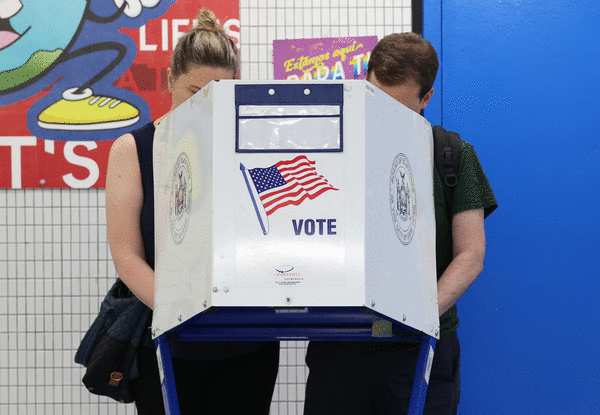
WASHINGTON — Democrats and voter advocacy groups are increasingly warning that Trump administration policies and actions could curtail voting in the midterm elections when it comes to changes on who can cast ballots and when it will count.
President Donald Trump and federal agencies have taken several steps over the past year they say will protect democracy and strengthen election integrity by ensuring those who cast ballots are eligible to vote.
Trump at first issued an executive order to force changes in state voting rules on registrations and counting deadlines, parts of which courts found violating federal administrative law or exceeding existing voting laws, and the Justice Department has sought state voter registration rolls.
The administration later this month will ask the Supreme Court at oral arguments to prevent the counting of ballots that show up after Election Day, which could throw a wrench in the elections this fall in the 30 states and the District of Columbia where at least some ballots that arrive in the following days can count.
Trump in recent days has joined the push for Congress to make changes, including calling for passage of legislation that would require photo identification and proof of citizenship to vote, as well as provisions that would sharply restrict mail-in ballots. Senate Majority Leader John Thune, R-S.D., told reporters this week he would have the Senate vote next week on a House-passed bill that contains some of the provisions Trump wants.
Many of the disputes over Trump’s efforts have been challenged in court, and Democrats and groups this week have filed lawsuits to get more information about potential Trump administration plans for sending the National Guard or immigration enforcement agents near polling places.
State election officials have expressed discomfort with Trump administration actions and say they violate the law and put voters’ information at risk.
Trump, in a podcast interview conducted last month, told former FBI deputy director Dan Bongino that he wanted to federalize elections, particularly in states run by Democrats.
“The Republicans ought to nationalize the voting,” Trump said.
Michael McNulty, the policy director at Issue One, a nonpartisan government watchdog group, is among experts who said the Constitution gives the president no independent powers over the election — that is left to the states and Congress in Article 1 Section 4.
McNulty said the Trump administration’s actions fall within a “larger election takeover playbook” that starts with sowing doubt in elections and then use that doubt to justify further actions.
“It’s very disheartening that this big threat, this significant election threat, is coming from the executive branch instead of people who might be outside the system who might be causing harm,” McNulty said.
David Becker, executive director and Co-Founder of the Center for Election Innovation & Research, an election research nonprofit, said Trump’s efforts could hurt efforts to vote, even if they are stopped by the courts.
“There is no question that the repeated lies, disinformation and the repeated attacks on public servants that run our elections that come from as high as the Oval Office have a really damaging effect,” Becker said.
The Trump administration efforts have some Democrats talking in apocalyptic language. Sen. Mark Warner, D-Va., posted a video Wednesday laying out potential efforts for the Trump administration to interfere in the election.
“If we have a corrupted election I don’t know how we ever come back,” Warner said.
Warner pointed to the efforts by the Trump administration, as well as the Justice Department’s actions tied to the 2020 election such as seizure of voter rolls in Fulton County, Ga., and seeking voter information in Arizona.
“All of this coming to pass with a president who has made it explicitly clear that he will do anything to protect his position in power,” Warner said.
House Democrats discussed countering the effort at their policy conference last month. Rep. Pete Aguilar, D-Calif., told reporters that House Administration Committee ranking member Joseph D. Morelle, D-N.Y., would brief the caucus on election issues and the Democratic Congressional Campaign Committee would be involved in “voter protection efforts.”
Trump efforts
Since coming into office in his second term, Trump has maintained his baseless claims of election fraud in 2020, including telling reporters on Wednesday at the White House that the 2020 results in Arizona were “rigged” and said reporters who asked for evidence were “rotten.”
Trump’s executive order in March 2025 purported to assert new presidential authority over elections, including requiring proof of citizenship for voter registration and voting and cutting off federal funds for states with laws allowing the counting of ballots that arrive after Election Day.
The Justice Department sued more than two dozen states that refused to comply with a request to turn over detailed voter data from almost every state. Those efforts are still wrapped up in dozens of lawsuits, and federal courts have temporarily paused most of them.
White House press secretary Karoline Leavitt last month said the administration was considering legal avenues to require photo ID at the polls this fall, regardless of Congress.
At a press conference Tuesday, Leavitt downplayed Democrats’ concerns about the legislation and Trump administration efforts to change voting rules.
“Passing the SAVE America Act is the most important thing that Republicans and, frankly, Democrats can do to strengthen election integrity and protect our democracy,” Leavitt told reporters.
Last month Leavitt downplayed concerns about Immigration and Customs Enforcement agents at polling locations as a “silly hypothetical” and said Trump was joking in January when he said the midterm elections should be canceled.
Most of the disputes over Trump’s efforts have landed in the federal courts, where dozens of judges have already ruled against the Trump administration.
Sophia Lin Lakin, director of the ACLU’s voter rights project, said the group and others would take steps to counter any effort to restrict voting rights.
“I don’t know how effective that will be, but it is part of that sort of multi-pronged, very aggressive attempt to really make it more difficult for segments of the population to vote,” Lakin said.
The ACLU has brought or intervened in dozens of cases against the Trump administration’s actions on voting. Democrat-led and some Republican-led states have also pushed back on the Trump administration, including in the fights over voter rolls.
On Tuesday, the Democratic National Committee filed a lawsuit against the Trump administration seeking access to documents on any plans to deploy federal agents or service members at the polls this fall. The lawsuit argued that the administration has not responded to multiple Freedom of Information Act requests seeking information about such deployments.
Last month, Sen. Alex Padilla, D-Calif., sent a letter to his colleagues outlining concerns over the “wildly illegal and unconstitutional” reported second executive order on elections and said he would introduce a resolution to overturn any national emergency declared to assert authority over elections.
“Put simply, no President has the power under the Constitution or any law to take over elections, and no declaration or order can create one out of thin air. Any such fake emergency should lack any force of law, and any attempted actions pursuant to such a declaration would face extremely strict scrutiny in the judicial system,” the letter said.
Padilla said in an interview he doesn’t trust the administration, citing the rumored order, as well as prior steps like last year’s executive order on voting and rumors about federal agents being deployed to the polls.
“Look, I don’t put anything past the Trump administration. They’re desperate and their only hope of holding on to power, the Republican majority specifically, is to play games with the November election,” Padilla said.
Supreme Court case
The Supreme Court will decide before the conclusion of the term at the end of June an appeal out of Mississippi, where the state is defending the constitutionality of laws that allow the counting of mail ballots that arrive after Election Day.
Counting ballots that arrive after Election Day has been a continuing legal issue and formed the basis in several of Trump’s failed lawsuits challenging state voting in states he lost in the 2020 election.
A ruling overturning those laws could create a headache for states to pivot their voting rules months ahead of an election, and there’s “not an insignificant number of races that this could, on the margins at least, impact,” McNulty said.
“What we’re seeing now is any vulnerability like that is being pursued. So we can anticipate that that would be another one would be pursued by the executive branch,” McNulty said.
Earlier this term the justices already allowed federal candidates to challenge the legality of state laws allowing counting of ballots that arrive after Election Day.
Becker said that those cases could combine for an “explosion” of litigation around Election Day that would ultimately put a cloud of suspicion on any result, no matter who won.
“A ruling like that could create a bunch of litigation and also lead to legitimacy problems for the eventual winner,” Becker said.
_____
©2026 CQ-Roll Call, Inc. Visit at rollcall.com. Distributed by Tribune Content Agency, LLC.















































Comments