How do we assess the millions California spends in its legal wars against Trump?
Published in Political News
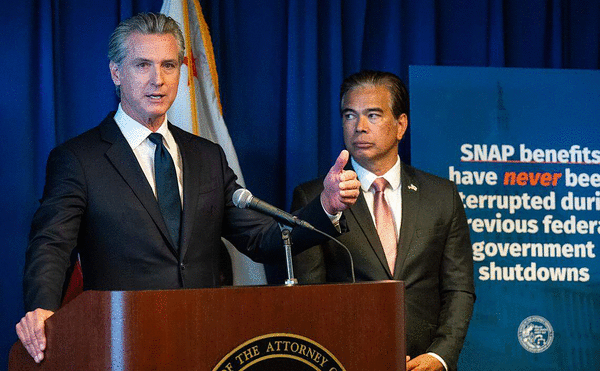
SACRAMENTO, Calif. — Since Donald Trump was sworn in for a second term last year, California has moved aggressively to push back against policies and actions the state’s Democratic leaders view as overreach.
The state’s lawyers are involved in more than 120 lawsuits against the Trump administration, from efforts to secure promised funding to such issues as control of the California National Guard, gender-affirming care for minors and the price of eggs.
In just over a year since Trump took office, the state filed more than 60 lawsuits against his administration and joined about 60 more as an amicus, or “friend of the court.” California was also named as a defendant in at least eight lawsuits filed by the administration.
It is an extensive effort that hasn’t come cheap.
Lawyers and other workers at the California Department of Justice devoted 92,212 hours working on lawsuits and policy letters related to the Trump administration in the 2024-25 budget cycle, at a cost of $20.4 million, a state budget request submitted by the department shows.
That’s enough work to keep 44 people employed full-time for a year, yet the majority of those hours were concentrated in just the five months from Trump’s inauguration through the end of the fiscal year in late June 2025. The state expended another 62,000 hours just from July through November, for a total of 154,000 hours expended over a period of about nine months.
The work is so expensive that the department has asked for an additional $10 million to cover the cost — enough to pay for 31 lawyers and analysts. The roughly $30 million appropriated for the 2025-26 budget will not be enough, the budget request said.
“We’re facing an administration that is breaking the law more than once a week, and our team is continuing to log overtime and work long nights and weekends to hold it accountable,” the office of Attorney General Rob Bonta said in a statement.
The expenditures, though a fraction of the state’s $321 billion spending plan, coincide with the state’s current financial strain. Health benefits, child care assistance and other services were rolled back for the poorest Californians and the state is contemplating keeping those cutbacks in place in the coming year.
The lawsuits highlight the vast policy differences between the liberal and moderate Democrats who dominate California politics and the conservatism of the Trump administration and most Republicans.
The state has become so well-known for challenging Trump with lawsuits that a left-leaning activist group recently hired trucks to cruise the streets around the state Capitol festooned with signs calling on Bonta to “Stop Trump’s Killer Robots,” a reference to the administration’s deal with the artificial intelligence company Open AI.
‘Suiting up for a fight’
Bonta’s office said California has more than paid for the cost of the litigation because many of the lawsuits involved demanding federal funding for state programs that the administration had threatened to withhold for political or other reasons.
By late last month, the state had recovered $188 billion in money meant for anti-poverty programs, education, public safety, medical research and other uses. Still other lawsuits tackled policy issues important to the state’s Democratic leadership, challenging Trump’s takeover of the California National Guard over the objections of Gov. Gavin Newsom and blocking the implementation of an executive order that would have imposed stringent voter identification requirements and banned the counting of late-arriving mail-in ballots.
But Republican leaders said the recovered funds might have been won for far less cost had the state been willing to negotiate with the Trump administration, rather than jumping immediately to lawsuits as the solution. They noted that the Legislature held a special session to appropriate $25 million to sue the administration in November 2024, months before Trump was inaugurated as president.
“We’re coming out of the blocks suiting up for a fight — just assuming that fight,” said state Sen. Roger Niello, a Fair Oaks Republican who is the ranking member of the Senate budget committee. “Why not use a more collaborative approach?”
Had California been willing to work with the administration, the state might have won the funding back without having to pay for the lawsuits, said Assembly member David Tangipa, a Fresno Republican who is the ranking member of the Assembly budget committee.
The U.S. Department of Justice, which defends the federal government against state lawsuits and has filed several suits against California, did not respond to multiple requests for comment.
Is California an outlier?
California is certainly not the only state suing the Trump administration for withholding funding that had been appropriated by Congress, or using the courts to fight policy initiatives it believes are illegal or unwarranted. Just this month, the state signed on to two lawsuits involving multiple states, one challenging Trump’s latest tariffs on imported goods and another fighting the administration’s demand for college admissions data broken down by race, gender and other characteristics.
And red states have filed lawsuits against Democratic presidents. Days after former President Joe Biden lost his bid for reelection to Trump in 2024, Texas Attorney General Ken Paxton announced that he had filed that state’s 100th lawsuit against the then-outgoing administration.
“For the past four years, the Biden-Harris administration routinely violated the Constitution to implement an agenda that harmed our nation,” Paxton declared. “We proudly led the nation’s fight to uphold the rule of law and restore constitutional rights when they were under attack.”
Newsom, who is widely believed to be eyeing a presidential run, has criticized Trump on social media while announcing some of the state’s key lawsuits, including one challenging the president’s tariff policies, and another challenging his takeover of the California National Guard.
After Trump’s election in late 2024, California set aside that $25 million in one-time funding in anticipation of the legal conflicts. The current budget includes about $16 million for lawsuits and other legal actions against the federal government, and Newsom is proposing to add another $20 million next year — $10 million from the special one-time fund and another $10 million from the general fund, budget documents show.
California’s first anti-Trump lawsuit was filed on Jan. 21, 2025, the day after Trump’s inauguration. It challenges the president’s executive order denying citizenship to babies who do not have at least one parent who is a U.S. citizen or legal permanent resident. The order ending birthright citizenship, one of 26 executive orders issued on the president’s first day in office, has been barred from taking effect by numerous courts and will be heard by the Supreme Court in a related case in April.
The lawsuits continue to be filed at a steady pace. On March 19, California challenged the repeal the recognition that greenhouse gases endanger public health. March 17, California joined other states to sue abut fair housing laws.
Another recent case, filed March 11, is the multistate effort opposing the administration’s demand that colleges provide detailed information about students offered admission, including race, gender and other characteristics.
Other recent actions included a lawsuit filed Feb. 24 in partnership with Arizona contesting the Trump administration’s revised childhood vaccine schedule, which removed seven vaccines, including those for COVID-19, hepatitis and flu, from the list of recommended immunizations.
The same day, Trump’s Justice Department announced that it had sued the University of California, accusing it of creating a hostile work environment and failing to protect Jewish students and faculty at UCLA from antisemitism.
Seeking to restore federal funds
In his state budget request, Bonta described the cases as “extremely successful” in bringing funding to California that had been halted or threatened by Trump’s tough tactics against blue states.
A legal challenge to an announced funding freeze, for example, freed up $168 billion in federal money that the state had been counting on, amounting to 34% of California’s budget, the request said. Another action preserved $2 billion in funding for the University of California and the California State University systems.
Yet another lawsuit protected $15.7 billion in funding for transportation.
On policy issues, many of the state’s lawsuits are still playing out, with some wins and some losses.
“DOJ’s work has been very impactful and also very time-consuming,” the department said in its budget request. The pace has been fast, with more than one lawsuit filed every week. Cases filed last year, meanwhile, must still be litigated, the request said.
“We expect that pace to continue, and yet DOJ continues to litigate the cases filed in 2025, so its demands are increasing,” the request said.
The volume of work required to prepare, file and argue the lawsuits — and respond to the ones filed against the state by the administration — can be seen in a breakdown that Bonta’s office included with its budget request. It details the number of hours spent on what’s known as federal accountability, meaning the legal letters, lawsuits and other filings made in relation to federal policies and proposals.
During the Biden administration, in the 2022-23 fiscal year, California lawyers and support staff spent about 8,500 hours on federal accountability issues, the budget request shows. The following fiscal year, 2023-24, they worked almost exactly the same number of hours, and were allocated about $3.5 million for their work.
But in the very next fiscal year, which included just five months of the incoming Trump administration, such legal work required 92,212 hours — 11 times more than the entire previous year. That work cost $20.4 million, more than the $16.7 million that had been allocated.
The additional $10 million the department is requesting would pay for two supervising attorneys, 25 attorneys, 3 senior legal analysts and one associate governmental program analyst, the request says.
More lawsuits than during the first Trump administration
The state is on pace to exceed the number of complaints it filed against the first Trump administration, when then-Attorney General Xavier Becerra filed about 120 lawsuits over four years, including nine on the president’s final day in office.
“This time after only one year there’s well over 50 suits,” Niello said, requiring tens of thousands of hours of work and costing even more than originally planned.
“We have since allocated additional money beyond that initial $25 million, in anticipation of continuing to use this ‘fight first and don’t talk’ approach,” he said.
But Mary-Beth Moylan, associate dean of the University of the Pacific McGeorge School of Law, said the high volume of cases during the current Trump administration — and the hours required to work on them — are not unexpected, because the president is moving quickly and using executive power in ways that also outpace even his earlier term.
“It’s not surprising at all because of the magnitude of the actions that have been taken by the federal executive branch in every area,” Moylan said. “In education, in health and human services, in immigration, in the economic world — every single department of the federal government has been majorly disrupted in the last 12 months.”
Becerra, who is now running for governor, said he sued Trump during his first term when the administration took actions he believed would harm the state. One such example, he said, was a successful fight he waged to force the federal government to pay for $57 million in funding for law enforcement that it had threatened to withhold. Two other legal actions challenged a federal effort to remove undocumented immigrants from states’ census counts, potentially reducing the number of seats California could hold in Congress and diminishing funding for various programs.
“We didn’t pick the fight,” Becerra said. “The federal government did. ... But we had a right to defend ourselves, and we won.”
_____
©2026 The Sacramento Bee. Visit sacbee.com. Distributed by Tribune Content Agency, LLC.















































Comments