'We can only win': The rise of the far right in eastern Germany
Published in Political News
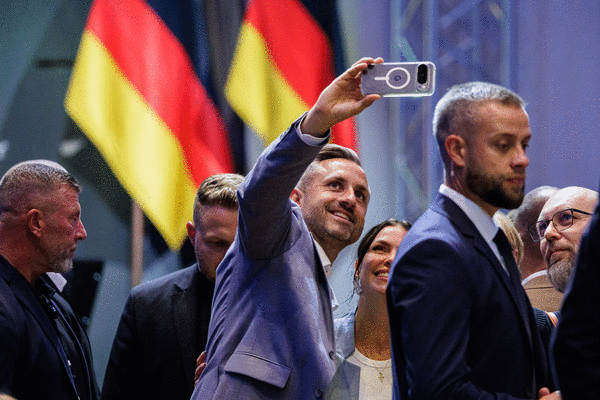
In a village on the edge of Germany’s Harz mountains, families gathering at a beer-and-bratwurst summer picnic lined up for autographs and selfies from the man they want to lead the country’s first far-right state government since World War II.
Ulrich Siegmund, leader of the Alternative for Germany party in the eastern state of Saxony-Anhalt, beamed with confidence that he’ll secure a victory that will deliver him a majority to lead the state after Sunday’s election. Should he fall short, he said, so be it. The political chaos that’s bound to ensue will last “a few months” – and the party will simply win the next election.
“Either way, we are the future, and I am looking positively toward this election,” Siegmund, an affable 35-year-old former businessman with a crisply side-parted coif, said in an interview in Röblingen am See last week. “We can only win.”
The optimism reflects the transformation of a party founded in 2013 to protest euro-area bailouts into a right-wing force that leads polls across Germany on a platform of deporting foreigners, reversing the shift to green energy and restoring ties with Russia. Its ascent, mirroring a broader populist surge across the continent, amounts to an urgent threat to the parties that have led Europe’s No. 1 economy for eight decades.
Chancellor Friedrich Merz has said the AfD would send Germany “into the abyss.” Business leaders have warned of deterring investment. Domestic counterintelligence has categorized elements of the party as a threat to the constitutional order. Policies that seek to marginalize minorities groups are a violation of Germany’s Basic Law, which guarantees human dignity, the agency has determined.
None of it has blunted the party’s rise — nor its ambitions to eventually take power nationally. Helped by Merz’s deepening slide in the polls — plumbing record lows for a postwar chancellor — the AfD is approaching 30% across the country. With all parties refusing to cooperate with the far right, the party is still far from power.
But in Saxony-Anhalt, a state of just over 2 million people and one of Germany’s poorest, the AfD has 43% support, according to an INSA poll on Wednesday. The Christian Democratic Union under Merz, which has governed the region in Germany’s former communist east since 2002, is well behind at 21%, it showed.
That’s left traditional parties scrambling to deny the far right an outright majority. Polling so far has shown the AfD just short of winning the most seats, but if the Social Democrats or Greens fail to meet a 5% threshold to enter state parliament, the redistributed seats in the assembly could put the AfD over the top.
The party’s leaders have promised radical change. Plans are being hatched to purge the ranks of civil servants in a bid to weed out those not aligned with AfD goals. An overhaul of the education system is designed to expunge it of “left-wing indoctrination.” At the center of the program is immigration: a proposal to launch a state-funded “deportation task force” to target those in the country illegally or for foreigners who commit crimes.
In Röblingen, Siegmund is straightforward about his objectives: withdrawing asylum and welfare benefits, cutting Ukrainian war refugees from unemployment benefits — and transforming reception centers into “deportation-detention centers.”
“We want to make things as uncomfortable as possible for people who want to exploit our system,” he said, estimating that some 4,000 people were already set for expulsion.
A salesman by training who once opened a business involved with commercial fragrances, Siegmund got his start in politics at 19 with the CDU and joined AfD the year after its founding. He’s broken the mold with some of his counterparts on the right as a polished speaker. But opponents have faulted his penchant for avoiding questions on some of the more controversial elements of the AfD’s plans.
His message on migration, however, resonated with Sabine, an office worker in her 40s from Halle who declined to give her last name. Speaking at the event in Röblingen, she listed her opposition to Germany’s aid to Ukraine and paltry pension benefits — but of above all migration — as the chief reasons she planned to cast her ballot for the AfD.
“First of all, get rid of those who have no right whatsoever to be here,” she said, at one point asserting that Muslims aim to become a demographic majority. Calling for deportations “has nothing to do with xenophobia,” she said, adding that her husband was a foreigner — and would vote AfD if he could.
The far-right party has coalesced around an ethno-nationalist ideology and shed many of the claims to be a “liberal-conservative” political force, according to Germany’s counterintelligence agency, the Federal Office for the Protection of the Constitution. In its annual report issued in June, it said an increased number of party officials have openly adopted the concept of “remigration,” or large-scale expulsions.
Many falsely portray the influx of migrants over the years as a government-sponsored program to displace native populations, a notion with ties to the far-right “Great Replacement” theory. The report makes reference to a more prevalent adoption of the German term “Umvolkung,” or a change of peoples, that was central to Nazi-era ideology.
At a former industrial site in Hettstedt not far from Röblingen, a crowd of several hundred gathered through the day for a “family fest” with food, beer and merchandise stands. Knickknacks included a German-flag-waving smurf figurine with a label: “Love of your homeland is not a crime.”
At the center, a line of some 150 people formed to meet Siegmund, many with a copy of Der Spiegel magazine with a cover from mid-August showing a mug-shot-style picture of the AfD leader, captioned “Germany’s Most Dangerous Man.” The cover was pilloried by German media for helping to elevate the state politician into a national anti-establishment hero. Siegmund grinned as he signed the copies.
Merz’s efforts to counter the AfD’s message have failed to gain traction. Deeply unpopular in Germany — but especially in the east — Merz has eschewed conventional campaigning. In an appearance on the Baltic coast in the state of Mecklenburg-Western Pomerania last week, where the AfD is expected to make gains in a Sept. 20 vote, Merz was heckled by a crowd during a walking tour.
In two appearances in Saxony-Anhalt over the last week, Merz was sealed off from contact with voters. He met Thursday with management and works council members of a chemicals plant in Leuna, Europe’s largest, where Finland’s UPM-Kymmene Oyj invested 1.3 billion euros ($1.5 billion) in a refinery that transforms wood into chemical elements.
“Anyone who wants Germany to remain an open and liberal country, and who wants Saxony-Anhalt to remain an interesting, also European location, must not vote for the AfD on Sunday,” Merz said in a brief statement to reporters after the visit, without taking questions.
The AfD has made its ascent despite isolation within Europe, even among far-right peers. France’s Marine Le Pen ended cooperation with the party in 2024 after an AfD lawmaker said in an interview that not every Nazi SS member should be considered a criminal. Italian Prime Minister Giorgia Meloni, whose Brothers of Italy has embraced transatlantic ties, has kept her distance given the AfD’s embrace of Russia.
At home, the party has persistently faced scrutiny over ties with more extreme elements. Siegmund’s campaign manager and two staffers in the state parliamentary group have past connections with a long-banned neo-Nazi group that organized camps around Third Reich ideology, according to an investigation by broadcaster ZDF.
The group, known as Heimattreue Deutsche Jugend, is on an AfD list of organizations that are incompatible with party membership. At a convention in Erfurt this year, Björn Höcke, the powerful leader of the AfD in the neighboring state of Thuringia, called for a revision of the list by imposing a statute of limitations and including groups including the Green party.
Asked about his aides’ links to extremist groups, Siegmund was dismissive — accusing media of “trying to dig this up” after years outside organizations such as HDJ.
“This is about camping in tents 25 years ago, which in my view is completely absurd,” Siegmund said. His campaign team was strong, he said, and he’ll take them with him if he wins the state premiership.
———
(With assistance from Arne Delfs and Michael Nienaber.)
©2026 Bloomberg L.P. Visit bloomberg.com. Distributed by Tribune Content Agency, LLC.
















Comments