Taiwan's envoy prods Trump administration on stalled arms sale
Published in Political News
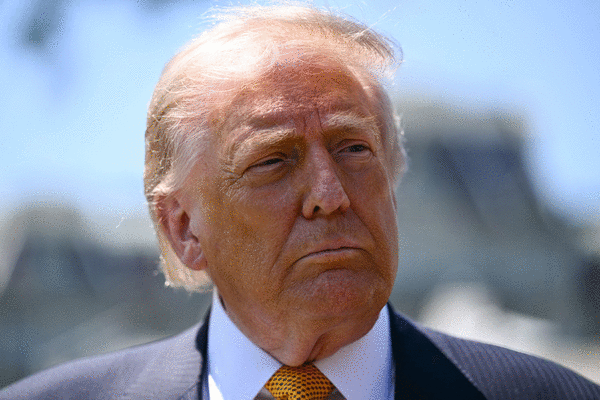
Taiwan’s representative to the U.S. projected confidence that President Donald Trump would ultimately approve additional weapons sales to the self-governing island, which has been waiting for a $14 billion arms package.
“Obviously the speed could be a little faster, but we hope the United States — the United States understands very well the threat that we are under and, I’m very sure, will be providing us with the necessary equipments,” Alexander Yui said on Bloomberg This Weekend with David Gura and Christina Ruffini.
Trump’s efforts to woo Chinese President Xi Jinping have sowed uncertainty about the U.S.’s commitment to Taiwan, raising the stakes for the arms sale. Air defenses make up a substantial share of the proposed package, people familiar with the matter have said.
Yui said the U.S. has been “very clear on the fact that there’s no change in US policy towards Taiwan.” He maintained the U.S. has not “acquiesced or responded” to Xi’s call to explicitly oppose Taiwanese independence, which would go beyond the longstanding policy that Washington doesn’t support independence.
A senior administration official, who requested anonymity to describe internal deliberations, said Trump would make a determination on the arms package in a fairly short time, without elaborating on the timeline. Trump, who downplayed the issue when he hosted Xi in Washington in September, has long said he would make the decision “soon.”
Trump has previously described arms sales to Taiwan as a “very good negotiating chip” in his dealings with Beijing, and has engaged on Taiwan with his Chinese counterpart in a manner that’s at odds with longstanding U.S. practice.
With Trump and Xi expected to meet two more times this year at international summits, Yui said the goal is “to make sure that Taiwan is not on the menu.”
Tension over Taiwan also played out as Chinese diplomats ensured at the last minute that the 1951 Treaty of San Francisco wouldn’t be displayed during the two leaders’ visit to the National Archives in Washington, according to a person familiar with the matter.
China didn’t sign the treaty, which forced Japan to relinquish its claims to Taiwan without specifying which government would assume sovereignty over the island.
The episode, first reported by National Public Radio, underscored Beijing’s sensitivity over Taiwan, which China considers part of its territory and has threatened to take by force if necessary.
As U.S. officials look to defuse concerns around support for Taipei, the senior administration official pointed to Trump’s approval of a record $11 billion in arms sales to Taiwan in December.
Republican House Speaker Mike Johnson last week cited Trump’s record on Taiwan, telling Fox Business that Taipei remains a “very important partner, friend and ally.” The delay in the latest package’s approval was related to “everything that’s involved and going on in the Middle East,” Johnson said.
But the uncertainty deepened this week after U.S. Ambassador to China David Perdue said Trump had asked Xi whether he wanted to purchase American weapons. Trump disputed the account before musing that selling weapons to Beijing might be a good idea.
A State Department spokesperson said U.S. law prohibits arms sales to China and there is no offer or plan to sell arms to China.
The stakes extend beyond the island itself. American support for Taiwan has long served as a measure of U.S. credibility in Asia, where allies including Japan and South Korea rely on Washington’s security commitments.
A failure to come to Taiwan’s aid in a crisis could also represent a significant geopolitical gain for Beijing, according to Jennifer Welch, chief geoeconomics analyst at Bloomberg Economics.
AI chips
Taiwan produces most of the world’s leading-edge semiconductors, making it indispensable to the artificial intelligence boom and the billions of dollars American companies are investing in data centers and advanced computing.
“None of that happens without Taiwan and without the chips that Taiwan makes,” Welch said.
For Taiwan, the more immediate concern is whether Washington will continue providing the military equipment it needs to defend itself against any Chinese attack.
A bipartisan group of U.S. senators urged Trump in May to formally notify Congress of the pending package. Separately, House Democrats called on the administration to reaffirm the longstanding so-called One China policy.
That policy recognizes Beijing as China’s sole legal government while acknowledging, without endorsing, its position that Taiwan is part of China. Washington maintains unofficial relations with Taipei and provides defensive weapons, while intentionally leaving ambiguous whether American forces would intervene militarily in a conflict.
Ryan Hass, a former National Security Council official now at Brookings Institution, said he expects additional arms sales during Trump’s presidency, potentially through smaller packages after the two leaders conclude reciprocal visits to the APEC summit in China in November and the Group of 20 meeting in Miami in December.
Even so, the delays and conflicting messages are having consequences.
“By introducing so much uncertainty about sort of the steadfastness of the United States,” Hass said Trump is “providing tailwind to China’s efforts to induce them to believe that they are isolated and alone in the world to contend with China.”
_____
(With assistance from David Gura and Christina Ruffini.)
_____
©2026 Bloomberg L.P. Visit bloomberg.com. Distributed by Tribune Content Agency, LLC.











































Comments