Tlaib bill aims to ban federal funding for Flock cameras
Published in Political News
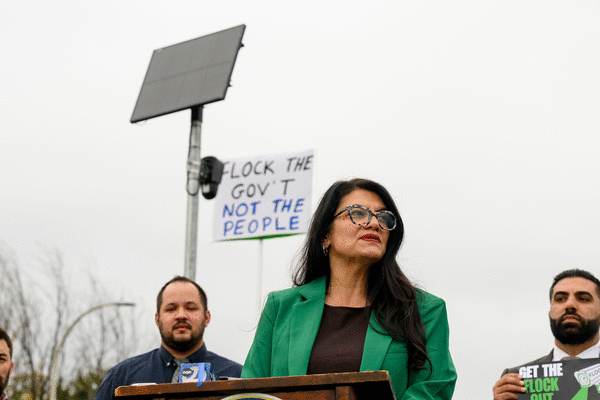
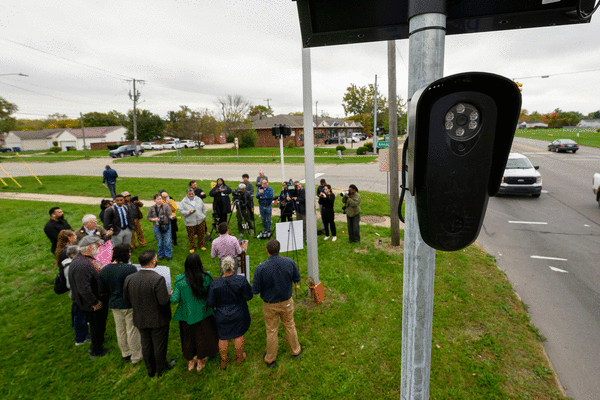
INKSTER, Mich. — Standing near a Flock camera, U.S. Rep. Rashida Tlaib on Wednesday touted a bill she's sponsoring that would ban federal agencies from using automated mass surveillance systems, including automatic license plate readers such as Flock.
Tlaib's "Get the Flock Out of Our Communities Act" would also ban federal funding for an array of technology used by many state and local municipalities nationwide, while also banning federal agencies from using artificial intelligence-powered mass surveillance technologies. It would also prohibit the use of federal funds often used by state and local municipalities to use the technology and require state and local governments to divest from such systems to remain eligible for certain federal grants.
"Let's be clear: this is about ... not allowing our neighborhoods to be in surveillance, and that mass surveillance does not make us safer," said Tlaib, a Detroit Democrat, during an Oct. 14 press conference in Inkster. "I'm going to say this again: when they pull up in our residences and have them come and tell them that somehow this is going to make us safer is a lie.
Flock Safety cameras are AI-enabled automated license plate readers that snap photos of passing vehicles and are used by roughly 180 law enforcement agencies in Michigan. According to Tlaib's office, Flock operated in over 5,000 communities across 49 states in 2025, and performed over 20 billion scans of vehicles in the U.S. every month.
Law enforcement officials say license plate readers are an important tool in solving crimes, but critics have increasingly raised concerns about the data the cameras capture, how it's used and who has access to it.
"Flock cameras and similar technology have already been used to stop women, track down patients who received abortions, repressed protesters, and those exercising their First Amendment right, and ... wrongfully arresting people in our community," said Tlaib.
Inkster, which is in Tlaib's district, was chosen as the city for Tlaib's press conference because the city just signed a 10-year contract with Flock.
"They may tell you it's for 10 years, but there is no end to the contract," Tlaib said. "Flock gets a final say on where the cameras go, and the perpetual license to use the data that they collect. Understand that we're not even protecting the data that they are collecting."
Inkster plans to increase its license plate readers from six to 20. The expansion will also include 48 gunshot detection devices and a drone designed to respond to emergencies. Mayor Byron Nolen said at a Oct. 12 press conference the technology is an effective crime prevention tool.
"This technology is another step forward for our city," Nolen said. "It's being proactive, preventing crime before it happens, responding faster when emergencies occur, and building a community that's united around safety and progress."
The city of Detroit operates more than 400 automatic license plate readers, including Flock, Tlaib said. Under her bill, municipalities like Detroit and Inkster would "need to remove all those cameras and any collected surveillance data in order to continue receiving federal law enforcement grants."
Tlaib's bill comes at a time when backlash is rising against Flock and similar technology.
Ten communities across Metro Detroit have decided to cancel their contracts with Flock over the last six months amid concerns about the data that is collected. Communities include Clawson, Westland, Milford, Independence Township, Sumpter Township, South Lyon, St. Clair Shores, Eastpointe, Lincoln Park, and Ferndale.
At the state level, there are no regulations for license plate readers, but bills have been introduced in both the House and Senate that would provide clear rules.
Senate Bill 1131 and House Bill 5493 would both limit data retention periods for agencies that use the cameras. The Senate bill would require police to have a warrant to access data outside of criminal investigations and missing person cases. House Bill 5493 would require agencies that use the cameras to publish quarterly reports detailing why plates were scanned and instances where they shared the data with external agencies.
Neither bill has made it out of committee for a full vote in its respective chamber.
Both bills have been opposed by Michigan Chiefs of Police Association Director Ron Wiles, who argues limiting data retention periods for license plate readers is counterproductive because criminal investigations don't happen on a fixed timeline. Both Sen. Jim Runestad and Rep. Doug Wozniak, the sponsors of the bills, say they wish to balance public safety with responsible use.
_____
©2026 The Detroit News. Visit detroitnews.com. Distributed by Tribune Content Agency, LLC.











































Comments