Commentary: If Israeli politics were rational, Arab parties would now be holding all the cards
Published in Political News
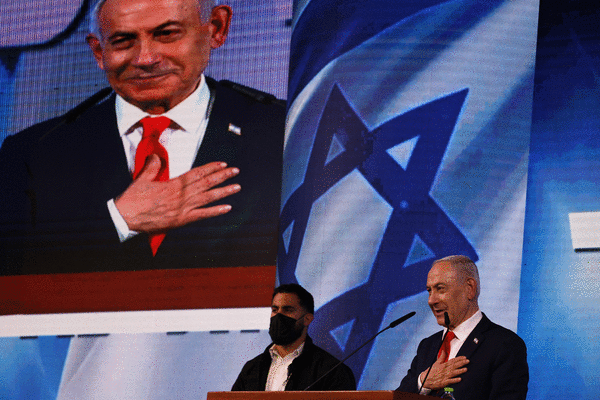
If a reporter for the Times of Mars covering the recent elections in Israel were to assess the results, she might file a story that would get this headline: “Historic Day: Arab Parties Score Decisive Win. Netanyahu Is Out.” She would note that there were three major blocs: the right-wing coalition of Prime Minister Benjamin Netanyahu with 53 seats (down from 64 in the last Knesset), the opposition coalition led by Gadi Eisenkot with 48 seats, and the Arab parties, which nearly doubled their total from 10 to 19 seats.
The Martian reporter would not need to be a world-class mathematician to understand that the most obvious way for either major bloc to get to the required 61 (out of 120) seats would be to forge a coalition with the Arab parties. Given Netanyahu’s long history of hostile policies and race-baiting, the Arab parties are committed to preventing him from remaining in power. And so too is the bloc led by Gadi Eisenkot. It would seem logical to strike a deal to get rid of Netanyahu after 17 years of corrupt, increasingly authoritarian rule.
But things are never that easy in Israeli politics. In the run-up to the election, Eisenkot said that none of the Arab parties — neither the moderate Islamist United Arab List nor the leftist Joint List (comprising three small parties) meet the criteria he laid out for inclusion in a government under his leadership. And the leaders of the other parties who are Eisenkot’s potential partners, Naftali Bennett (Beyachad) and Avigdor Liberman (Yisrael Beitenu), have declared that they would not sit in a government with Arab parties.
This is a constant refrain in Israeli political life. Only once has an independent Arab party been invited to sit in a governing coalition. As it were, it was the United Arab List in the short-lived government led by Bennett in 2021.
How can it be that a political system whose leaders regularly describe it as a functioning democracy exclude parties representing 20% of the population? And could it really be that the Jewish opponents of Netanyahu would prefer to let him stay in power rather than sit with Arab members of Knesset?
Bennett told a group of American students in March 2025 that members of a future government that he might lead “must be Zionists, and that means the next government won’t include Arab parties.” His about-face came after Oct. 7, 2023, when the level of fear and anger toward Palestinians by Israeli Jews soared to unprecedented levels.
Liberman, for his part, has a long history of seeking to disenfranchise Arab citizens of Israel, including by redrawing the country’s borders to exclude large concentrations of them. He reaffirmed his policy in recent days, declaring“neither Bibi nor Tibi” (referring to Netanyahu, on one hand, and Arab Member of Knesset Ahmad Tibi, on the other).
One can understand why Jews would be fearful after Oct. 7. But it is surprising that so few of them grasp how fearful Palestinians are of Israelis. The power differential is vast, with Israel possessing the ability to inflict catastrophic harm at a scale many times greater than Oct. 7 (as seen in Gaza), allow settlers to terrorize local residents (as seen in the West Bank) and provide preferential treatment to Jews within Israel proper.
The problem is not situational fear. It is structural discrimination. Arabs have formal citizenship rights in Israel, but in fundamental regards, they are second-class citizens. They do not serve, with only a few exceptions, in the Israeli army, which accords its former soldiers ample material benefits and social legitimacy. They lag far behind in terms of educational and economic opportunity, the result of government privileging of Jews over Arabs in public funding for schools, municipal infrastructure and law enforcement. The last area is of particular importance given the epidemic of organized crime that has raged in Arab communities in recent years.
In one especially candid observation, an Israeli government commission led by a former Supreme Court justice averred in 2003: “The state did not do enough or try hard enough to create equality for its Arab citizens or to uproot discriminatory or unjust phenomenon.” This remains true today. And it was true in 1948, when the state was created as a home for Jews. Shortly after the state’s founding, areas with large Arab populations were placed under military rule, with serious restrictions on the right of assembly, movement and speech, that lasted for 18 years until 1966.
Notwithstanding this discrimination, Arab citizens have been overwhelmingly productive and loyal citizens of the state. True, they have not declared themselves as Zionists. Most would prefer that Israel not be defined as a state of the Jews but rather as a state of all its citizens. And who can blame them? Why should that be a crime or a rationale for political exclusion?
Israel faces a moment of truth. After the devastation of Gaza, its standing in the world has never been lower, with many observers asking how and why its exclusionary, monoethnic political system can be tolerated. The existing rules of the political game there that preclude full Arab participation are illogical, immoral and counterproductive. The system requires a total reset.
Unlikely as the prospect seems, Eisenkot and his prospective partners have the opportunity to take a historic step. They can cash in on the remarkable turnout of Arab voters to end a dangerous, racist regime and begin a long-overdue process of repair. Such a step will not solve all of Israel’s many problems, but it will augur a long-overdue day of more equality and justice in the country.
____
David N. Myers teaches Jewish history at UCLA.
©2026 Los Angeles Times. Visit at latimes.com. Distributed by Tribune Content Agency, LLC.




































Comments