Nvidia to buy Hugging Face for $13 billion in open-source push
Published in Business News
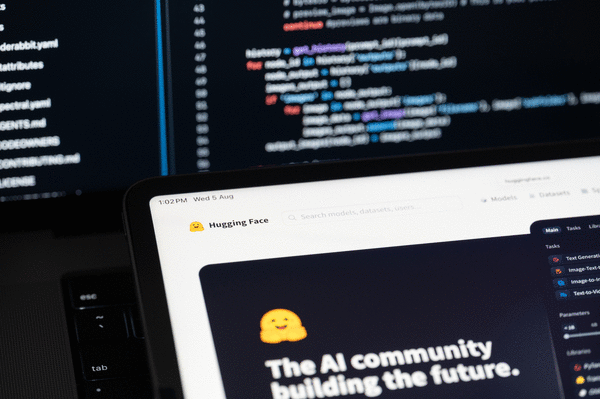
Nvidia Corp. agreed to acquire artificial intelligence startup Hugging Face in a transaction valued at about $13 billion, adding a popular software platform to the chip giant’s AI empire.
The price includes an equity-based retention program of as much as $1 billion for Hugging Face employees who join Nvidia, according to a statement Thursday.
Nvidia touted the deal as a way to protect open-source AI developers, who rely on Hugging Face to share software and data that can be freely used by anyone. Chief Executive Officer Jensen Huang has emerged as a strong advocate for open-source AI models as a means of keeping the technology broadly available and preventing it from becoming concentrated in the hands of a few massive players.
OpenAI, Anthropic PBC and other big AI developers mostly rely on closed models that are proprietary. In buying Hugging Face, Nvidia vowed to keep the platform open.
“Open models strengthen safety and cybersecurity, accelerate innovation and diffusion, and enable sovereignty,” Huang said in a post on X. “Nvidia is going to be a great home for Hugging Face, its community and the future of open models.”
Still, Nvidia’s move raises its own questions about the concentration of power in AI. It’s already the biggest company in the industry, and acquiring Hugging Face will only add to its influence. A previous attempt to buy chip designer Arm was opposed by regulators because of the sway it would give Nvidia.
“The company now sits closer to the entire AI supply chain: compute, models, datasets and developer workflows,” Forrester Research Inc. analyst Jeff Pollard said in a note.
“That creates an opportunity to improve AI security,” he said. “It also concentrates influence over a critical piece of the open AI ecosystem.”
Buying Hugging Face is one of the biggest moves yet in Huang’s push to broaden the uptake of AI and extend his customer list. Bloomberg News reported earlier that Nvidia was set to reach an agreement as soon as this week.
“Under this commitment, Hugging Face would continue to permit model makers, developers, and users to upload and download models and datasets of their choosing and to support other silicon vendors,” according to Thursday’s statement.
Nvidia shares rose about 2% to $229.88 at 1:52 p.m. in New York, adding roughly $132 billion to its $5.5 trillion market value.
Nvidia was already a backer of Hugging Face, alongside Alphabet Inc.’s Google, Amazon.com Inc., Intel Corp. and Salesforce Inc., among others.
Founded in 2016, Hugging Face was valued at $4.5 billion in a funding round three years ago. Nvidia’s talks with the company were reported earlier by Business Insider.
Hugging Face was at the center of a cybersecurity incident in which a model being tested by OpenAI inadvertently hacked the platform. The breach raised alarms about the safety of cutting-edge AI technology. OpenAI has said it could have reacted sooner to prevent the attack on Hugging Face’s systems.
That incident was one driver of the company’s decision to sell, Thomas Wolf, co-founder and chief science officer of Hugging Face, said in an interview on Bloomberg Television.
“Either we raise more money and double down or we find someone who shares our values and our mission deeply, and we partner with them,” Wolf said.
Wolf and Hugging Face’s other founders — Clement “Clem” Delangue and Julien Chaumond — initially began business in Paris, naming the company after the “hugging face” emoji. They joined billionaire Xavier Niel’s startup campus Station F, located in a redeveloped, century-old freight station in Paris.
In a post on LinkedIn ahead of the deal announcement, Station F said the three first arrived in 2017 to develop a chatbot for teenagers, then pivoted, began raising money, and were set to become a “titan of an exit.”
Delangue has said they homed in on the idea of creating a platform for open-source models after co-founder Wolf spent a weekend repackaging Google’s “Bert” model and then putting it online to great acclaim.
Delangue, Chaumond and Wolf will each have a net worth of about $1.8 billion once the deal is done, according to the Bloomberg Billionaires Index, which is valuing their fortunes for the first time.
The acquisition of Hugging Face adds to a list of deals struck by Nvidia in the past year, including a $6 billion licensing agreement in August with startup Poolside that included extending job offers to many of that company’s employees. Nvidia also reportedly paid about $20 billion for most of the chip startup Groq.
But Nvidia’s most ambitious deal, the $40 billion bid for Arm, crumbled in 2022 after pushback from regulators and customers.
The dealmaking spree has some observers raising antitrust concerns about the Hugging Face purchase.
“I think it’s a process and we’ll see — we are confident,” Wolf said in the interview. “We think there is a nice path where Hugging Face continues to operate as an independent, open platform as in the past.”
David Sacks, a tech investor and former AI czar for the Trump administration, praised the deal in a post on X.
“It’s great to see Nvidia supporting open-source AI in a big way,” he said. “Keeping innovation decentralized and accessible is the key to avoiding an unsafe and dystopian future where advanced AI capabilities are centralized and controlled by only a few hands.”
Nvidia, the world’s most valuable company, is the leading maker of AI accelerators, the chips that help train and operate models. It has gradually added a variety of other technologies, including software and networking equipment, with the goal of expanding the AI economy.
The Santa Clara, California-based company gave a surprisingly strong sales forecast for fiscal 2028 last week, saying revenue would grow about 70%.
©2026 Bloomberg L.P. Visit bloomberg.com. Distributed by Tribune Content Agency, LLC.








Comments