Trial over Abbott Laboratories' formula for premature babies set to begin in Chicago this week
Published in News & Features
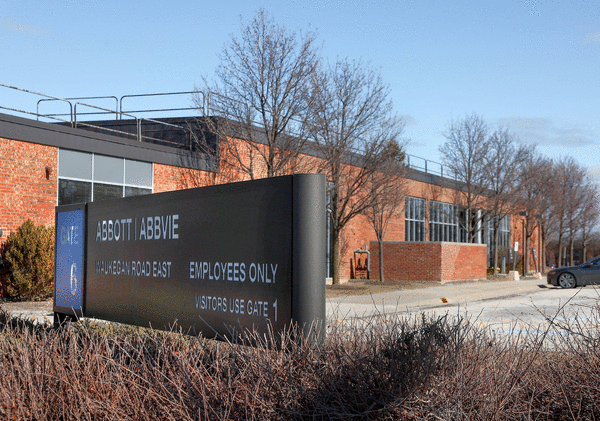
CHICAGO — The latest chapter in an ongoing legal battle between Abbott Laboratories and parents of babies born prematurely is slated to play out in Chicago this week — with the beginning of a trial that could have implications for the company and families across the country.
North suburban-based Abbott has been entangled in litigation with parents for years over whether its specialized, cow’s milk-based formulas for infants born prematurely cause a life-threatening intestinal disease called necrotizing enterocolitis.
Abbott now faces more than 1,700 lawsuits over the issue in courts across the country. But so far, only two cases against Abbott have gone to trial — both in Missouri state court.
Now, for the first time in Cook County Circuit Court, cases over the matter are scheduled to go to trial, with jury selection set to start Wednesday.
The stakes are high for Abbott and for families of babies born prematurely.
For Abbott, hundreds of millions of dollars are on the line. In one of the cases that already went to trial in Missouri, the jury returned a $495 million verdict against Abbott, though that case is now under appeal.
The potential implications are even larger for families. While the parents say in their lawsuits that Abbott must be held accountable, the company’s CEO has suggested that Abbott could pull the specialized formula altogether because of the flood of litigation.
The American Academy of Pediatrics has previously warned that the specialized formulas are a “routine and necessary” part of care for some infants, and steps must be taken to “protect the supply of infant formula for those who need it.”
“The last thing you want is for companies like Abbott to say, ‘The headaches are not worth it. We’re simply going to stop making this product,’ because then that leaves parents of preterm infants in a very, very precarious place,” said Peter Pitts, a former associate commissioner at the FDA and president and co-founder of the Center for Medicine in the Public Interest.
Attorneys for plaintiffs in other, similar cases, however, say Abbott’s threat to pull the formulas is a scare tactic.
Abbott declined to comment for this article, as did attorneys for the parents whose cases are heading to trial this week. The trial could last about six to eight weeks.
The heart of the cases
The trial scheduled for later this week involves four lawsuits, going to trial together, all filed in 2022 by Illinois parents whose babies were born prematurely at Chicago area hospitals between 2012 and 2019.
Though the complaints are short on personal details, they all contain the same basic allegations: prematurely born babies fell ill and are now suffering from long-term health problems as a result of consuming Abbott’s cow’s milk-based products.
The parents behind the lawsuits contend that Abbott failed to provide warnings about the risks of its products, was negligent, and misrepresented the safety of the products — all allegations that Abbott denies in court documents.
Abbott has argued in court documents that the babies’ injuries were “the result of unavoidable circumstances” and that the “benefits of Abbott’s products outweigh the risks, if any, that might be associated with the product.”
At the heart of the cases is the question of whether Abbott’s specialized formulas caused the babies to contract NEC, a disease in which tissue lining the intestine becomes inflamed and dies. Preterm and low-birth-weight babies are at higher risk than full-term babies of developing NEC, potentially because of their immature digestive systems, according to the National Institutes of Health. Research indicates 15% to 40% of infants with the disease die.
A study published in 2024 found the risk of NEC in preterm babies, born before 29 weeks of pregnancy, who were fed formula was twice as high as in those fed donated breast milk — echoing findings from other past studies. The U.S. surgeon general in 2011 also acknowledged that formula feeding is associated with higher rates of NEC for premature infants.
It remains unclear, however, exactly what causes NEC. Some pre-term babies who drink only breast milk also develop the disease.
In 2024, three major government agencies — the U.S. Food and Drug Administration, the Centers for Disease Control and Prevention and the National Institutes of Health — released a joint statement on NEC and premature infants, following a report by a group of experts who were asked to compile information about the science behind the issue.
In that statement, the agencies said, “There is no conclusive evidence that preterm infant formula causes NEC.”
“Available evidence supports the hypothesis that it is the absence of human milk — rather than the exposure to formula — that is associated with an increase in the risk of NEC,” according to the statement.
The agencies wrote that “important scientific gaps exist” when it comes to understanding NEC and how feeding practices may relate to it.
Those findings should be important when juries consider whether Abbott is liable, critics of the lawsuits say.
“They’re terrible,” Pitts said of the situations where infants got sick or died with NEC. “But the tort bar relies on emotion to win these cases rather than the law, regulatory science or the facts.”
Attorneys who have represented parents in similar cases, however, say even if the cause of NEC isn’t totally clear, it’s enough that formula feeding is associated with higher rates of NEC in preterm infants.
“The semantics about … definitive causation, is all sort of nonsense when a mother or father is in a room trying to decide how to feed their child and you don’t tell them anything about (the increased risk of NEC with formula feeding),” said Tor Hoerman, an attorney representing parents involved in other, similar cases in Cook County and around the country.
“If something increases the risk of a terrible disease, tell me,” he said.
Hoerman represents the mother who filed the lawsuit that resulted in a $495 million verdict against Abbott in 2024.
Abbott, however, has argued in court documents that it wouldn’t have made a difference in the cases set to go to trial this week if Abbott had provided a warning about the products because the parents didn’t read the packaging. Also, Abbott contends, in three of the four cases, medical providers gave parents information about NEC risks and nutrition, and in three of the cases, formula was the only option for feeding the infants, as there was no mother’s milk or donated breast milk available at the hospitals for them at the time.
“Indeed, in three of the cases, the NICU medical treaters gave the Plaintiff-parents information about NEC risks and nutrition — the same thing they presumably wanted to hear from Abbott — and even so, formula was given,” Abbott said in a court document. “There is no basis to infer that a different warning from Abbott would have produced a different treatment.”
Lobbying and litigation
Abbott has been exploring multiple ways to get relief when it comes to the debate over the safety of its preterm infant formulas.
In the past, Abbott CEO Robert Ford has suggested that the company could drop the products entirely if Abbott keeps facing litigation. The specialized formulas account for a very small part of Abbott’s revenue, though attorneys for parents suing the company say the formulas help Abbott build brand loyalty and secure hospital contracts.
Abbott has also proposed giving up control over sales and distribution of the formulas to the federal government “to protect the long-term supply for American babies and their doctors,” an Abbott spokesperson previously said in a statement.
When asked if the government would consider it, a spokesperson for the U.S. Department of Health and Human Services said it does not comment on pending litigation. Abbott declined to comment on the government’s response for this article.
Disclosure forms also show that Abbott has been actively lobbying for legislation on the issue. Last year, a Tennessee lawmaker introduced a bill that would temporarily preempt certain lawsuits against Abbott and other manufacturers of specialized formulas for preterm infants while the FDA studies the issue.
That bill, however, hasn’t made any progress since it was introduced a year ago, meaning cases like the ones scheduled for trial this week continue to move forward.
Of the two cases that have been heard in state court so far against Abbott, one resulted in the $495 million verdict against Abbott. In the other, Abbott and Mead Johnson Nutrition, another company that also makes formulas for babies born prematurely, were found not liable for a boy developing NEC. But a St. Louis judge later granted a motion for a new trial citing “errors and misconduct” in the original trial. Abbott is appealing that decision.
Another similar case also went to trial in St. Clair County, Ill., but that case was filed against Mead Johnson, not Abbott. In that case, the jury decided on a $60 million verdict against Mead Johnson.
Hundreds of cases have also been filed in federal court in Chicago. Four of those cases were chosen as bellwether cases, meaning their outcomes are meant to help guide how all the other cases in federal court in Chicago might proceed, and/or how to settle those cases. So far, three of those bellwether cases were thrown out before they went to trial. The fourth bellwether case is scheduled to go to trial in July.
Though the four cases scheduled for trial in Cook County Circuit Court this week are not technically considered bellwether cases, the hope is that they could serve a similar purpose, said Elizabeth Kaveny, who is representing dozens of parents who’ve filed other lawsuits in federal court and state courts.
“It can hopefully lead to meaningful settlement discussions between the parties so hundreds of (cases) would not need to be tried,” Kaveny said.
So far, Abbott has not settled any of the cases.
“At this point in the litigation, we hopefully win and Abbott will change their conduct, but even if the jury doesn’t come back in the plaintiffs’ favor, it doesn’t change that we will continue,” Hoerman said.
____
©2026 Chicago Tribune. Visit at chicagotribune.com. Distributed by Tribune Content Agency, LLC.





Comments