Senate committee to decide how Moore can spend taxpayer dollars
Published in News & Features
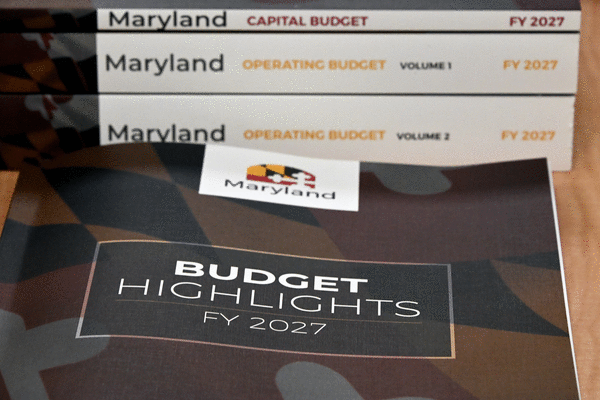
BALTIMORE — The Maryland Senate Budget and Taxation Committee on Thursday will either approve, limit, or eliminate numerous budget cuts and fund transfers proposed in Gov. Wes Moore’s fiscal year 2027 budget, which funds the state’s day-to-day costs, with a majority of it financing healthcare, education, and public safety programs.
The committee’s decision kicks off the General Assembly’s deliberations on how the Maryland governor can spend taxpayer dollars and other sources of income to close a projected $1.4 billion budget shortfall and fund his policy priorities.
Next week, the 13-member Senate committee will introduce its amended budget to the full Senate chamber, where lawmakers will debate, vote, and if approved, move their changes to the House of Delegates. If the House comes to a different conclusion than the Senate, budget negotiators from both chambers will meet for a joint conference to iron out these differences. This conference is scheduled to take place at the end of this month. Once both chambers reach an agreement, they’ll vote on the final version of the budget that is then sent to the governor’s desk for approval.
The General Assembly will also undergo a similar process with Moore’s capital budget proposal, which funds long-term construction projects. Moore’s office did not respond to a request for comment by the publication deadline.
Senate Budget and Taxation Chair Guy Guzzone praised this year’s proposal. “We started with what I consider a pretty darn good budget from the administration,” Guzzone said.
Republicans, so far, have criticized Moore’s plans as “accounting tricks” that do little to remedy Maryland’s bleak financial outlook. Republican leadership has also cautioned that Moore’s budget not raising taxes and fees distracts from the burden it could place on local municipalities, where the governor has proposed to restructure cost-sharing agreements between local jurisdictions and the state. Now, they’re looking to see if Democrats will make convenient budget moves to aid themselves during an election year.
“We’re going to be on the lookout if there are policies that are kicking the can further down the road, after the election, for convenience,” House Minority Whip Jesse Pippy told The Baltimore Sun. “Because at the end of the day, as we’ve always said in our caucus, it’s the taxpayers’ money. We need to be better stewards and fiduciary agents of the taxpayer to make sure that Maryland is affordable and that we’re not spending money we don’t have.”
Disability advocates have pushed back on Moore’s budget, arguing that the proposed $150 million in cuts to the Developmental Disabilities Administration (DDA) could jeopardize its ability to administer life-saving care. Energy advocates have also spoken out against a proposed $292 million cut to the Strategic Energy Investment Fund (SEIF), arguing that this could undermine Maryland’s long-term climate goals and efforts to protect low-income residents from rising energy costs, especially as Baltimore Gas and Electric (BGE) bills skyrocket.
Guzzone said that funding for DDA and the SEIF are likely to be the top two issues lawmakers debate on the longest.
House Appropriations Committee chair Ben Barnes told The Sun that while budget negotiations are often complex, he anticipates this year’s will be “less acrimonious,” unlike last year, when Moore and lawmakers were at odds over how to close a $3 billion deficit. The result was across-the-board increases on numerous taxes and fees.
Barnes added that Annapolis lawmakers will keep intact the record investments Moore has made in education, public safety and housing.
“We have a pretty good FY2027 situation and outlook,” Barnes said. “There’ll be some changes, which we’re continuing to work with the governor and his staff on. We’ve been working on maybe trying to leave [intact] our really robust rainy day fund of $2.2 billion, [and] maybe increasing our cash surplus.”
Both Barnes and Guzzone anticipate Maryland’s cash surplus could increase if Maryland’s Board of Revenue estimates announces revenue increases on Wednesday.
Barnes added that there’s been an uptick in how much the state has received in sales taxes. Revenue from income taxes has also remained steady, Barnes said.
Any revenue the board announces on Wednesday will go to Maryland’s FY2026 operating budget, which the state is currently operating under. But any surplus at the end of FY2026 will carry over to the FY2027 budget, which becomes effective in July.
_____
©2026 The Baltimore Sun. Visit at baltimoresun.com. Distributed by Tribune Content Agency, LLC.






Comments