Maryland AG sues ICE for records on Baltimore holding room conditions
Published in News & Features
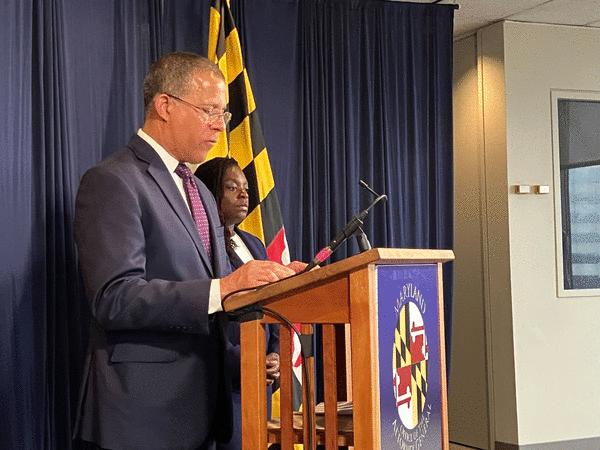
BALTIMORE — Maryland’s attorney general sued federal immigration authorities Tuesday, accusing them of blocking an investigation into alleged inhumane conditions inside the “holding rooms” at the Baltimore federal building.
Attorney General Anthony G. Brown filed the lawsuit against U.S. Immigration and Customs Enforcement and the U.S. Department of Homeland Security, seeking to force the agencies to comply with an administrative subpoena for records tied to detention conditions at the George H. Fallon Federal Building.
The subpoena is part of a civil rights investigation by the attorney general’s office into whether ICE has engaged in a pattern of constitutional violations against people detained in the building’s short-term “holding rooms.”
ICE officials told The Baltimore Sun they have already said everything that can be shared publicly about the matter. The agency denied Brown’s subpoena Feb. 25, arguing the requests were overly broad, unduly burdensome and implicated privacy protections. When Brown’s office asked for partially responsive or redacted records, ICE said it would need until April 6 to determine whether it could release any information.
“The conditions inside the Baltimore holding cells have been dangerous, inhumane and unlawful — and ICE and DHS have done everything in their power to keep us from finding out just how bad they are,” Brown said in a statement.
Gov. Wes Moore in a statement said he supported Brown, adding the allegations surrounding the Baltimore facility “are deeply disturbing and merit full investigative cooperation.”
Looking into hold room conditions
In the lawsuit, Brown said his office started monitoring the holding rooms in summer 2025 after reviewing viral video, detainee declarations filed in litigation and media reports about visits by members of Congress. The office formally opened an investigation in January into whether ICE has engaged in a pattern of civil rights violations, including overcrowding, denial of medical care, lack of food and water and unsanitary conditions.
Declarations filed in a related class-action lawsuit describe as many as 40 to 50 people confined in rooms measuring about 15 by 15 feet, forcing some detainees to sleep sitting up without bedding in cold conditions. A federal court reviewing that case found March 6 that detainees in the Baltimore hold rooms are “routinely held there overnight and in excess of 12 hours” — and sometimes for more than 72 hours — in conditions that likely violate the Fifth Amendment.
The allegations include detainees being denied medication, hygiene products and basic sanitation. One declaration described a person forced to remain in an adult diaper for five days after not receiving sanitary supplies. Another described a detainee with leukemia who was denied cancer medication for two days until a friend brought it to the facility.
City residents speak up about conditions
At a Baltimore City Council public safety hearing Tuesday, Mark Conway, chair of the committee, read written testimony from a first responder who said they were called to the Fallon building in December when a detainee suffered a seizure.
“The hallways and the holding rooms were lined in grime,” the medic wrote, adding that the man was seizing on the floor while “none of the DHS employees were displaying any concern or urgency.” As medics approached, several detainees began banging on the glass asking for medical care, the testimony said.
At the same hearing, Baltimore Councilman Mark Parker pointed to the lawsuit as an example of local officials pushing back amid broader federal immigration enforcement changes.
“You see today that Attorney General Brown filed suit over the conditions at the Fallon building,” Parker said. “We’re grateful for his work … and for all of our partners pushing for justice every single possible way we can.”
The lawsuit, filed in the U.S. District Court for the District of Maryland, asks a judge to order ICE and DHS to produce the subpoenaed records. Brown’s office argues the agencies’ refusal violates the Administrative Procedure Act because it was unlawful, arbitrary or unreasonably delayed.
________
©2026 The Baltimore Sun. Visit at baltimoresun.com. Distributed by Tribune Content Agency, LLC.






Comments