Questions remain after ODU asks students to reveal criminal history in the name of heightened safety
Published in News & Features
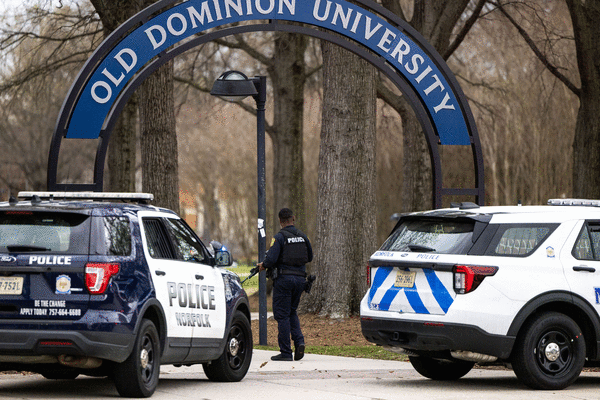
NORFOLK, Va. — Old Dominion University said it would not punish students who fail to respond to a questionnaire about their criminal histories, and maintained it took the unusual step in the name of campus safety.
“We understand that students may have concerns, and we want to be clear that this effort is grounded in care for our community,” Kimberly Osborne, Vice President for University Communications and Chief Marketing Officer, said in a statement Friday.
There has been no indication that Mohamed Bailor Jalloh’s status as an ODU student helped him attack a classroom in Constant Hall last week and kill Lt. Col. Brandon Shah. Some students and faculty members questioned the criminal history questionnaire and the lack of clarity surrounding how the university would act upon students’ answers.
“We are not going to speculate on any individual case or hypothetical scenario. Campus safety requires a layered approach, and no single measure can fully prevent acts of violence,” Osborne said.
Under Virginia law, ODU and other public colleges are restricted from questioning applicants about their criminal histories or denying admission on the basis of criminal history. Colleges can only use self-reporting and voluntary disclosure to ask students of their histories. According to a university spokesperson, ODU was unaware of Jalloh’s criminal history.
In the Thursday night message sent to enrolled and newly admitted students, the university maintains it has the authority to ask and act upon knowledge of an individual’s criminal history after they are enrolled, should officials become aware of one.
Students were asked to complete the questionnaire by March 26. University officials said their answers would be handled with “care and discretion” and would be known only to limited, unspecified personnel.
The questionnaire is “one component of a broader, layered approach to campus safety” the university has taken, Osborne said. Each situation would be reviewed carefully and individually, and a prior conviction does not automatically result in a specific action, she said, echoing the language of the Thursday message to students.
“The objective is to contribute to a more informed and proactive understanding of our campus environment,” her statement said.
The two yes or no questions students were asked:
1. Have you ever pled guilty, no contest, or been convicted of any felony?
2. Within the past 10 years, have you pled guilty, no contest, or been convicted of a misdemeanor crime involving violence or the threat of violence in any court?
The questions excluded juvenile court proceedings. If answered yes, a section appeared so they could elaborate. The university said it would not exclude students from ODU systems for not answering the survey.
When asked where, specifically, the idea to broadcast a questionnaire seeking students to disclose their criminal histories came from, Osborne said, “This was an internal university decision informed by leadership and relevant campus offices as part of our responsibility to support campus safety and well-being.”
Marc Ouellette, chair of the university’s Faculty Senate undergraduate academic policy and procedure committee, said he learned of the questionnaire long after it had been sent out. In past initiatives, he said, he’s worked closely with university leadership in streamlining and executing the process.
“Is this going to be a one-time thing or is this going to be a policy?” he said. “We still really want to know what the actual purpose of it is for.”
Ouellette, an associate English professor, said he and other members of the ODU community were left with more questions than answers when they learned of the survey. He said it sent a contradictory message, on one hand offering to help but on the offer not disclosing what would happen with the collected data or how exactly it would be used.
The vagueness in what will come out of the questionnaire led Ouellette and others to question how students with criminal backgrounds perhaps trying to turn around their lives will be treated.
“I hold out hope that we can bring back that sense of togetherness,” he said. “Shared governance.”
©2026 The Virginian-Pilot. Visit pilotonline.com. Distributed by Tribune Content Agency, LLC.






Comments