Oldest astronaut Buzz Aldrin turns 96 as new moon astronauts share Apollo inspirations
Published in Science & Technology News
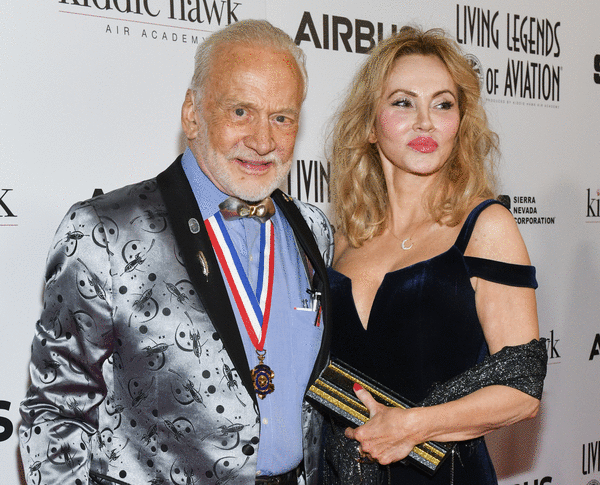
Buzz Aldrin, the second man and only one of 12 to ever walk on the moon, turns 96 today. He’s just one of four living moonwalkers and the oldest remaining astronaut still making trips around the sun.
Edwin Eugene Aldrin Jr. followed Neil Armstrong onto the lunar surfaces as part of the Apollo 11 landing in 1969 as a 39-year-old. He was born on Monday, Jan. 20, 1930, in Glen Ridge, New Jersey, the only son and youngest of three children of Edwin Aldrin and wife Marion, whose maiden name was Moon.
According to History.com, his nickname Buzz was the shortened version of “Buzzer,” the result of a mispronunciation of “brother” by one of his older sisters. He changed that to be his legal first name in 1988.
While this past year has not been kind to Aldrin, who lost his wife last fall after a battle with cancer, he’s remained a cheerleader to NASA, which is primed to soon add to the list of humans who have traveled to the moon with the upcoming Artemis II mission.
After landing on July 20, 1969, Aldrin spent 93 minutes walking on the moon along with Armstrong, the first two of 12 men across six successful moon landing missions between 1969-1972. Armstrong died in 2012 while their command module pilot Michael Collins, who orbited the moon while they ventured to the surface, passed away in 2021.
The only other moonwalkers still alive are Apollo 15’s David Scott, 93, Apollo 16’s Charles Duke, 90, and Apollo 17’s Harrison Schmitt, 90. Apollo 13’s Fred Haise, 92, who flew to the moon, but did not land, is alive as well. Also alive is Scott’s Apollo 9 crewmate Rusty Schweickart, 90, although that mission didn’t leave Earth’s orbit.
The Artemis astronauts wished Aldrin happy birthday this past weekend from Kennedy Space Center as their ride to the moon, the Orion spacecraft atop the Space Launch System rocket, rolled from the Vehicle Assembly Building to Launch Pad 39-B, much like the Apollo mission’s Saturn V rockets did during the Apollo program.
NASA astronauts Reid Wiseman, Victor Glover and Christina Koch as well as Canadian Space Agency astronaut Jeremy Hansen, are slated to be the first humans to return to the vicinity of the moon since then on a launch that could fly as early as Feb. 6. Glover will be the first Black man, Koch the first woman and Hansen the first non-American to venture so far from Earth.
All four shared their inspiration from their Apollo predecessors, even though some have passed away in the last few years.
Wiseman said that on the day he was selected for Artemis II, his phone rang from Apollo 10’s Gen. Tom Stafford, but that he almost didn’t pick it up.
“I didn’t have the number saved. It was a it was a Florida number, and I was thinking it was a telemarketer. I was on my couch. I was getting ready to take a nap. It had been a long day with the media, and I almost hit the red hang up button, but I just figured I would answer it,” he said.
Mimicking the gravelly, forthright voice of Stafford, who died in 2024, Wiseman said he told him, “‘Reid. Congratulations! We are so excited for you,'”
Wiseman said he thinks that’s the way the Apollo crews have always been.
“They are so fired up that we are headed back to the moon. They are so fired up that we’re going on to Mars. They just want to see humans as far away from Earth as possible, discovering the unknown, the near impossible,” Wiseman said.
He also noted that the four of them grew up in the era of the space shuttle and International Space Station.
“We do feel like this is an Apollo legacy, but for the four of us here, we are standing on the shoulders of the International Space Station and the science, the research, the long duration exposure they have had, and what we have learned up there.”
Glover, who flew to the space station in 2020 as part of the Crew-1 mission, paid particular tribute to Apollo 9’s Schweickart.
“Rusty gave me a bag of wisdom, quotes from different cultures all over the world that I took to the space station, and I’m going to take that little bag of wisdom, but also in my heart and mind, the wisdom that we’ve learned from Charlie Duke and Gen. Stafford and Dr. Schmidt on what it meant to them,” he said. “And some of the story that hasn’t even come out yet. You know, we’re still learning things from the Apollo era, and so it’ll be nice to take the baton, run our best race and then hopefully pass that baton on to Artemis 100.”
Koch, who will become the first woman to travel past the moon said the Apollo astronauts taught her about camaraderie.
“Seeing the way they interact with each other, seeing the way they tell stories, and the way they still love each other and being around each other, and what they went through together and how that bonded them has been really instrumental for me in appreciating every single day with my crew and with the larger teams,” she said.
The Artemis II mission will actually break the record set by Apollo 13 for distance traveled from the Earth with a plan to go farther than the 248,655-mile distance that crew hit during their flight in 1970. Koch said she heard from one of its crew members after the mission plan was announced.
“I will never forget seeing Fred Haise at one of these remembrance events, shaking his hand, and before I even said, ‘Hello sir, great to see you,’ he goes, ‘I heard you’re going to break our record,'” Koch said. “And at that moment, he brought me into that camaraderie, and I made a promise that I will carry that forward and keep everyone in that spirit of camaraderie and carry it through our mission as well.”
Hansen said the Apollo 11 landing was one of the most inspirational drivers for him to become an astronaut.
“I think that’s how I ended up here. I saw a picture when I was a kid of a human standing on the moon. It was either Buzz or Neil. But it just changed my perspective on things,” he said. “I turned my treehouse into a spaceship, started exploring space in my imagination, and here I am all those years later.”
He noted the Artemis II have as required reading Apollo 11’s command module pilot’s Michael Collins book, “Carrying the Fire.”
“He does a great job of putting the human perspective in what was accomplished during Apollo. And it was pretty extraordinary,” Hansen said. “We’re doing extraordinary things now, but we can create even greater things in the future. We should not accept this as status quo. We should always be striving for more.”
He noted that the feats of Apollo were a balance of safety and accomplishment.
“They also weren’t cavalier. They were taking calculated risks, and I think it’s a great example for us to remind ourselves, ‘Hey, we’re gonna go out there, we’re gonna take some appropriate risk, and we’re going to accomplish some extraordinary things. We’re gonna have some failures, some setbacks along the way, and then we’re gonna pick ourselves back up and keep going,” Hansen said.
Aldrin also flew on Gemini 12, the final crewed mission of the Gemini program flying with Jim Lovell and performing several spacewalks in 1966. Lovell, who also flew on Apollo 8 around the moon and Apollo 13, which had to abort its moon landing attempt, died last August at age 97, making Aldrin the oldest remaining astronaut alive.
“Grieving the loss of one of my best friends, Jim Lovell,” Aldrin posted on his X account after Lovell’s death. “His extraordinary legacy is cemented by many space missions: Gemini VII, Gemini XII, Apollo 8 and Apollo 13. Our mutual respect had no limits. The Gemini XII mission we flew together paved the way for the Apollo missions. Heartfelt condolences to Jim’s family. Farewell Jim. You will be missed, my friend. Godspeed!”
Aldrin has been off social media since the passing of his wife Anca Faur, who he married on his 93rd birthday in 2023. The two had been living together in Los Angeles, but she died last October at age 66.
Reports of Aldrin’s declining health prompted a post from his family through the Melbourne-based Aldrin Family Foundation. Aldrin had lived in Satellite Beach for several years while also working with the Florida Institute of Technology.
“Thank you everyone for your support and best wishes for Buzz since losing his wife, Anca. He is, of course, still grieving the loss of the true love of his life. But we’ve had a wonderful holiday with him in the Los Angeles home that he and Anca shared since they were married,” the foundation stated in a post Dec. 26 credited to his children Jan and Andy Aldrin. “We cooked and watched football, talked on the phone with relatives and then enjoyed a beautiful Christmas dinner together.”
The post showed images of Aldrin wearing with oxygen tubes, but standing with grandchildren wearing a T-shirt featuring an astronaut on the moon holding an American flag and the phrase, “Dibs.”
“He will soon be moving closer to his family in Southern California. We spent time yesterday looking at the pictures and videos of his beautiful new home with panoramic views of the city and ocean,” the post continued. “Best of all, we are looking forward to spending more time with him and ensuring he lives the absolute best life possible.”
©2026 Orlando Sentinel. Visit at orlandosentinel.com. Distributed by Tribune Content Agency, LLC.






Comments