Top Republicans throw cold water on 'nationalizing' elections
Published in Political News
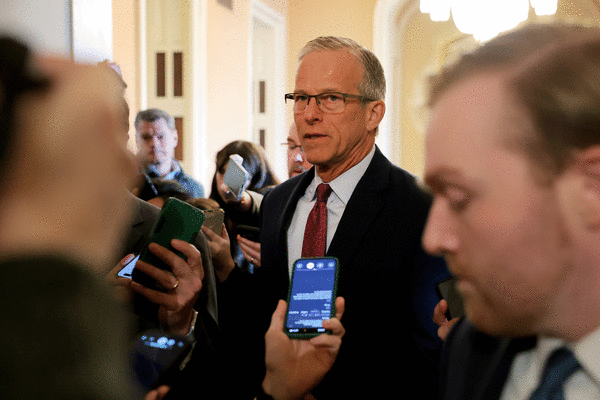
WASHINGTON — As many Republicans in Congress push for action on a voter ID bill, its future remains uncertain — and key voices in the GOP say they are wary of increasing federal involvement in elections.
“I’m supportive of only citizens voting and showing ID at polling places. I think that makes sense … but I’m not in favor of federalizing elections. I mean, I think that’s a constitutional issue,” Senate Majority Leader John Thune, R-S.D., told reporters Tuesday.
“I’m a big believer in decentralized and distributed power, and I think it’s harder to hack 50 elections systems than it is to hack one,” Thune said.
The bill, known as the SAVE Act, would require American voters to provide proof of citizenship to register to vote in federal elections. It has become a rallying cry for House Republicans in recent days, with Rep. Anna Paulina Luna, R-Fla., and others threatening to derail must-pass spending bills unless their demands were met.
The group eventually backed down, saying they had reason to hope they would see action “in the coming weeks” on a newly revamped version, dubbed the SAVE America Act, that would also add a photo ID requirement at the polls. It was introduced in the House by Rep. Chip Roy, R-Texas, and in the Senate by Sen. Mike Lee, R-Utah.
“I think that the president wants this, and I think that he’s going to heavily get behind it,” Luna said.
But adding new mandates for how states administer their elections is a sticking point for some.
While the SAVE Act passed the House in April, it has yet to see action in the Senate. Rep. Brandon Gill, R-Texas, led a letter on Monday urging Senate Rules and Administration Chair Mitch McConnell, R-Ky., to advance the legislation through his committee, saying it was “past due.”
McConnell, however, is one of a small handful of Republicans who have not signed on as co-sponsors of the SAVE Act. Asked about his position on the bill, his office pointed to a Wall Street Journal op-ed he wrote in April arguing that increasing federal involvement in elections is a slippery slope.
While many states have voter ID requirements of their own, a federal mandate would be different.
“Elections may have national consequences but the power to conduct them rests in state capitols. No public mandate, real or perceived, lets Washington tamper with this authority, not even for a worthy cause like election integrity,” McConnell wrote at the time, pushing back on an executive order signed by President Donald Trump in March.
Pointing to the 2002 creation of the Election Assistance Commission as an example of reasonable federal action, he cautioned against going too far as the partisan pendulum swings.
“The Trump administration can, and should, support state-led efforts to authenticate voter rolls, train election officials, upgrade voting technologies, and combat voter fraud. But they ought to be careful. Even a targeted federal mandate to strengthen election integrity today could make it easier for a future Democratic president and Congress to use more sweeping mandates to carry out a complete federal takeover of American elections,” McConnell wrote in the op-ed.
‘More that needs to be done’
Asked Tuesday about Thune’s position that elections should largely remain “decentralized,” Gill pushed back, saying elections across the states are already intertwined.
“Whenever you have a state like Texas — or any Republican state who has to abide by the election results that are impacted by mass illegal immigration that the Democrats lawlessly pursued for four years — alongside an election system in blue states that doesn’t protect against illegal aliens or foreign nationals voting in our election system, I think that that argument starts to crumble quite a bit,” Gill said.
In an interview on the Dan Bongino Show released Monday, Trump said Republicans “ought to nationalize the voting” and “take over the voting.” White House press secretary Karoline Leavitt told reporters on Tuesday that he was referring to voter ID requirements and the SAVE Act.
After the House wrapped up its spending work for the week, narrowly avoiding a Republican revolt over the voter ID issue, Majority Leader Steve Scalise sounded an optimistic note. “We’re going to move that through the process quickly, get it over to the Senate, and we want to see that bill on the president’s desk. And the president has made that a top priority,” Scalise said of the voter ID bill.
And Luna emerged from a White House meeting earlier this week suggesting the Senate could get things moving by bypassing its usual 60-vote threshold and employing a strategy known as a standing filibuster. Thune, however, indicated to reporters that he had not made that assurance directly and nothing was decided.
Meanwhile, as the midterms approach in November, House Republicans are looking for other ways to draw attention to their election messaging. The House Administration Committee announced a hearing scheduled for Feb. 10 on “how to restore trust and integrity in federal elections.” It comes after the chair of the panel, Rep. Bryan Steil, R-Wis., introduced a slate of proposals that would not only establish federal voter ID and citizenship verification requirements, but also ban ranked-choice voting and universal vote by mail. He tied the package to Trump’s campaign slogan, dubbing it the Make Elections Great Again Act.
Democrats have largely dismissed Republicans’ “election integrity” efforts, saying they only make it harder for citizens to vote and perpetuate Trump’s unsubstantiated claims of widespread fraud in the 2020 election.
“President Trump and House Republicans are terrified of the American people. They are desperate to rig the system so they can choose their voters,” House Administration ranking member Joseph D. Morelle, D-N.Y., said in a statement last week.
Steil said his bill is a “comprehensive” blueprint for Republicans.
“It’s the list of reforms that we truly need to get our elections back in line and to reinstall the integrity that I believe we can have. There’s more that needs to be done than just what’s in SAVE. SAVE is an important bill, but there are other reforms, which we list out in MEGA, from paper ballots to clean voter rolls,” he said.
_____
(Jacob Fulton and Jackie Wang contributed to this report.)
_____
©2025 CQ-Roll Call, Inc. Visit at rollcall.com. Distributed by Tribune Content Agency, LLC.
















































Comments