Brazil markets crater, some stocks sink 50% after Lula's victory
Published in Political News
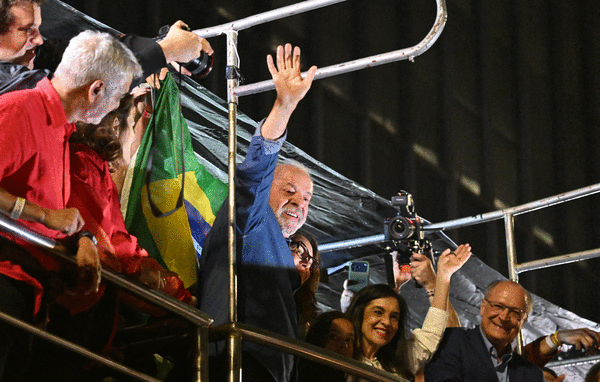
SAO PAULO, Brazil — Brazilian markets cratered, with the currency and the benchmark stock index quickly racking up losses of more than 10%, as the surprise reelection of leftist President Luiz Inácio Lula da Silva blew up the bullish wagers that investors had made on the country in recent weeks.
The speed and magnitude of the rout — multiple trading halts were triggered just minutes after the opening bell rang and some shares lost more than 50% — revealed the extent to which investors had been counting on an end to the Lula administration and the massive budget deficits it has rung up.
They had put their hopes in Flávio Bolsonaro, a right-wing candidate who had made vague pledges to slash the deficit, and frantically bid up Brazilian assets after he posted a surprise victory in the first round of the vote three weeks ago. Monday’s declines more than wiped out those gains.
Curbing the deficit is crucial to bringing down the country’s double-digit borrowing costs and, in turn, revitalizing Latin America’s biggest economy, which has been sluggish for years. With those prospects seemingly crushed by Lula’s victory, traders pushed swap rates higher Monday, sending some contracts up more than three percentage points.
The slump in Brazil’s real was the steepest in more than two decades. The Ibovespa Index tumbled 17% at one point as markets resumed trading after triggering a circuit breaker at the open. It was the first time that mechanism took effect since early 2020. It’s also the benchmark’s sharpest drop since the outbreak of the pandemic.
“Election rhetoric is now giving way to economic reality,” said Chiara Salghini, a portfolio manager at Vontobel Quality Growth.
Swap rates steadied modestly after Brazil’s Treasury said it will hold an auction to buy back local fixed-rate notes. However, the rout in the country’s assets reflects investor concerns that Lula is unlikely to take the steps needed to curb a budget gap exceeding 9% of the economy.
In fact, a series of measures that Lula unveiled in recent weeks, including debt relief for so-called microentrepreneurs, added to investor concerns about the stretched fiscal position. His administration is seen as more inclined to maintain social benefits and stimulate consumption through credit, while relying largely on revenue increases to shore up public finances. The result only ramps up the focus on Lula’s choice as the next finance minister and his fiscal plans.
Trading Limits
The moves were so sharp that exchange operator B3 widened trading limits for several key markets on Monday, allowing for larger-than-usual moves in the currency, interest rates and stock-index futures. The changes apply only to Monday’s regular trading session.
“I have been following the markets since 2001, and I have only seen the magnitude and voracity displayed today on a few rare occasions like Sept. 11, and during the pandemic,” said Eduardo Cohn, a portfolio manager at Heritage Capital Partners.
An exchange-traded fund tracking Brazilian stocks slumped as much as 26% in New York, the most since its debut in 2000. Declines for more than half of the stocks in the Ibovespa exceeded double digits, with some falling by as much as 60%. Small caps, which are heavily influenced by interest-rate expectations, saw a historic selloff. A benchmark for the group, which includes most listed retailers and homebuilders, declined 30% — the most on record.
Brazilian dollar bonds sank across the curve, underperforming emerging-market peers, with some notes losing about 2.5 cents.
Bullish Calls
Lula won 51.8% of the runoff vote. Bolsonaro got 48.2%, according to Brazil’s electoral court. Bolsonaro called for the annulment of the result, accusing the Supreme Court of changing the rules when it mandated a last-minute extension of voting hours.
Investors had largely positioned for a Bolsonaro victory after his surprise lead in the first-round vote earlier this month triggered a major rally, drawing in billions of foreign flows on hopes of a much-demanded fiscal tightening. Firms including UBS Global Wealth Management, Morgan Stanley, JPMorgan Chase & Co., and Citigroup Inc. rushed to put out bullish calls for Brazilian assets.
As polls continued to point to a tight runoff as Lula rolled out a string of voter-friendly measures, many started ramping up hedges in order to protect their portfolios. But a Bolsonaro win was still largely seen as the base-case.
After Lula’s victory, JPMorgan downgraded Brazil’s currency and rates to market-weight from overweight. Bradesco BBI lowered its outlook for the nation’s stocks to neutral.
Wells Fargo, however, called the immediate reaction to the vote “overdone.” While the deteriorating fiscal picture has been “concerning,” strategist Alvaro Vivanco said he expects enough fiscal steps at the beginning of the new government to contain the risks, especially for the real.
He recommended buying the real at about 5.56 per dollar, around its weakest level Monday, and sees it strengthening toward 5.30 under a Lula government.
Fiscal Woes
Since returning to office in January 2023, Lula, an 80-year-old former union leader, has sought to improve the lives of working Brazilians by boosting consumption and building on a credit expansion that took off during the pandemic. But he’s done little to address the country’s soaring deficits, which investors say are the reason the nation has some of the highest real rates in the world.
Brazil’s fiscal problems run deep, and the strain is showing across the economy. Household delinquencies are at a record, millions of companies are behind on payments and farmers are defaulting at an unprecedented pace. The government itself has little room to maneuver, with public debt above 80% of GDP and a budget that is largely tied up in mandatory spending.
Doubts about Lula’s commitment to reining in the fiscal deficit came to a head in late 2024. A selloff sent the real to a record low and engulfed everything from stocks to local-currency debt and dollar bonds.
Still, Brazilian markets have followed a rocky but ultimately positive path in his third term in office. High rates, while restrictive for the economy, make the currency appealing to carry traders amid a weaker dollar and a push away from U.S. markets that has helped lift emerging markets more broadly.
“This result is a continuation of current policies — more fiscal spending, inflation running higher for longer and more public investment,” said Ales Koutny, head of international rates at Vanguard’s active funds. “Due to the current fiscal picture in Brazil, this leads to limited room for interest-rate cuts and a need for elevated higher real rates will remain.”
_____
(With assistance from Vinícius Andrade, Abhishek Vishnoi, Ruth Carson, Marcus Wong and Ravil Shirodkar.)
©2026 Bloomberg L.P. Visit bloomberg.com. Distributed by Tribune Content Agency, LLC.
















































Comments