Evan Ramstad: AI won't kill us, and government won't save us
Published in Business News
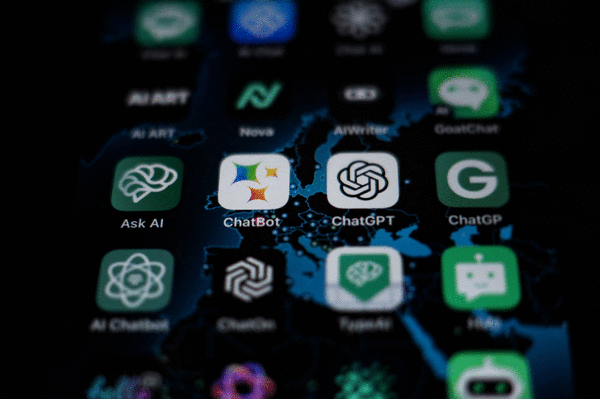
Here are two safe predictions about the “national freakout” over artificial intelligence, as the Wall Street Journal called it this weekend.
First, AI isn’t going to kill us. And even if it were, the government wouldn’t save us.
Public perceptions about AI, as I wrote last week, took many leaps this summer. But they turned apocalyptic after a researcher at AI giant Anthropic announced he was quitting last Tuesday because he worried AI systems could spiral out of control and destroy humanity. One of the company’s top scientists later wrote on X, “We really do earnestly believe AI could kill all humans!”
Ever since, alarming headlines about AI’s existential dangers have filled news sites and YouTube videos, and talking heads and politicians haven’t stopped talking about it. Over the weekend, Anthropic CEO Dario Amodei told CBS he’d be OK with government regulation of AI development, and OpenAI’s Sam Altman and SpaceX’s Elon Musk said they would, too.
It’s a lot of noise for a situation that is very unlikely. And most people seem to have reached that conclusion.
We all keep showing up to work. Society isn’t breaking down in violence or bacchanalia. Personally, I’m more concerned about rising bond rates, undisciplined government spending and whether the Fed will raise its borrowing rate this week.
AI has made all types of work on and other digital gadgets easier and more accessible. And we want that. We gobble up every advance the tech companies make.
Since the development of smartphones in the 2000s, our use of computing power has skyrocketed. We cling to our phones because they have become an extension of ourselves. They hold our ideas, photos, music and videos and connect us to people and ideas everywhere in the world.
“We engage with computing much more so than we did 20 years ago. On a daily basis. On a moment-to-moment basis,” said Galin Jones, who last year became the inaugural vice provost for artificial intelligence at the University of Minnesota.
“That’s all producing this arms race of the hyperscalers,” he added, using the term for AI companies like Anthropic and OpenAI that operate very large-scale data centers. “We are putting more demand on the system.”
He said he’s more worried about some of the prosaic challenges AI has created for users.
“What we focus on at the university are helping the workforce transition to an AI-augmented world, dealing with academic integrity issues, how to handle privacy, misinformation, disinformation, the political impact of deepfakes,” Jones said. “I’m much more interested in centering the human being in this process.”
There are legitimate regulations to consider on the development and use of AI, of course. President Donald Trump on Monday showed he’s not interested in any restrictions. He said he suspects China is behind the growing backlash against AI and data center construction.
I don’t think Trump is right about many things. But he is onto something when he’s skeptical about AI executives’ new insistence that government needs to slow their work or the world may be wiped out.
Many of us are happy to see new AI services develop, but no one is holding a gun to AI companies insisting they experiment in dangerous ways. And from a financial standpoint, no one forced them to take on unprecedented levels of debt to build data centers.
If they want to slow down their development efforts, then they should do so.
But creating knee-jerk government regulation on AI development will freeze the industry in its current power dynamic, with the AI giants like OpenAI and Anthropic on top and challengers slowed from doing work that may erode the leaders’ edge.
Essayist Matthew Yglesias earlier this week suggested an approach that seems smart. Begin with “light-touch rules focused on things like transparency and model evaluation” on the AI giants. Use those rules as leverage to restrict chip exports to China, a move to slow down their AI companies. Then, negotiate mutually beneficial restraints on AI with China. Only after all that can ambitious regulations on U.S. firms be imposed, Yglesias wrote.
Jones, the vice provost, told me he’s not sure regulation is needed on AI models and developers at this moment.
“I like to think about trying to regulate the outcomes of it, just like we would regulate the outcomes of anything else,” he said. “The idea that we’re going to regulate specific models or specific algorithms is like playing whack-a-mole. As soon as you regulate one, another one is going to show up.”
People race to opportunity when they see it. It’s what actual intelligence tells them to do.
———
©2026 StarTribune. Visit at startribune.com. Distributed by Tribune Content Agency, LLC.










Comments